
Walmart vs Amazon: 10 differences PPC managers need to know
What separates the two marketplaces on cost and access, and what separates Walmart Connect from Amazon Ads once the campaigns are live. Written from both ad accounts, with the screens.
By Serhii Khyshchenko, Team Lead (external traffic), UNITIX Agency
See more UNITIX in Google
Add UNITIX to your Preferred Sources.
In July 2026 Amazon took first place on the Fortune Global 500, at roughly $717 billion in revenue against Walmart's $713 billion. Fortune's own announcement puts it plainly: Amazon ended Walmart's twelve year run at the top. Four billion dollars now separate the two largest companies in the world, and a brand deciding where to put its advertising is standing between them.
Amazon $716.9B, 9th on the list in 2020 and 1st in 2026
Walmart $713.2B, 1st in 2020 and 2nd in 2026
The gap between them: $244B in 2020, $3.7B now.
The numbers
| Fortune Global 500 list | Amazon | Walmart | Gap |
|---|---|---|---|
| 2020 | $280.5B | $524.0B | $243.5B |
| 2021 | $386.1B | $559.2B | $173.1B |
| 2022 | $469.8B | $572.8B | $103B |
| 2023 | $514.0B | $611.3B | $97.3B |
| 2024 | $574.8B | $648.1B | $73.3B |
| 2025 | $638.0B | $681.0B | $43B |
| 2026 | $716.9B | $713.2B | Amazon ahead by $3.7B |
Two different questions get asked in the same sentence. The first is whether Walmart is worth adding at all. The second is whether the Amazon account can simply be copied across. The answer to the first depends on your category and your margins. The answer to the second is no, and this piece is mostly about why.
Short answer. Walmart Connect and Amazon Ads look alike and should not be run the same way. The differences that decide how an account is managed are product targeting, negative keywords, automatic campaign control, bid adjustments, campaign grouping and reporting latency. Walmart publishes minimum bids and lets you bid differently by device; Amazon does neither. Amazon lets you bid on a competitor's product and shows you yesterday; Walmart does neither.
Last tested: September 2026, in both consoles, against each platform's own documentation. The screenshots are our own, taken in accounts we run. Account names, brands, products, campaign names and keywords are blurred in every one of them, so nothing that identifies a client appears here.
The marketplace, before the advertising


- Where you can sell
- AmazonStores across the Americas, Europe, Asia Pacific and the Middle East, from one Global Selling account
- WalmartOne Marketplace account covers the US and can be extended to Canada, Mexico and Chile
- Getting in
- AmazonOpen registration, with some categories gated
- WalmartAn application: business tax ID (an SSN is not accepted), GS1 GTINs, a record of ecommerce success, and US fulfilment with returns capability
- Account cost
- Amazon$39.99 a month on the Professional plan, or $0.99 per item sold on the Individual plan
- WalmartNo setup fee and no monthly fee
- Referral fee
- AmazonVaries by category, most between 8% and 15%
- WalmartVaries by category and by price, roughly 6% to 15%, up to 20% on jewellery below $250
- Fulfilment
- AmazonFBA or your own
- WalmartWFS or your own
- Minimum ad bid
- AmazonNo single published minimum across Sponsored Ads
- Walmart$0.20 automatic Sponsored Products, $0.30 keyword Sponsored Products, $0.50 Sponsored Brands and Sponsored Videos
- Yesterday's numbers
- AmazonAvailable, with conversions still filling in
- WalmartUsually not: the last complete day is the day before yesterday
The practical reading of that table is short. Trying Walmart costs nothing to hold, because there is no monthly fee, so the real cost of entry is the application and the catalogue work behind it. Amazon lets almost anyone list tomorrow and charges a subscription for the privilege.
One claim that circulates in every comparison is worth treating carefully: that Walmart has less competition. Walmart does not publish a seller count that can be cited next to Amazon's, so that statement is an impression rather than a measurement. What can be measured is competition inside a search: how much of the clicks on a phrase the top few products already take. That is a number you can pull per keyword, per marketplace, and it varies far more by category than by platform, as our measurement of 1.2 million keywords showed on the Amazon side.
Where the ad platforms diverge
Feature by feature, in one table. Every line is expanded further down, with the screen it was taken from.
- Grouping above the campaign
- Amazon AdsPortfolios
- Walmart ConnectNone
- Product targeting in Sponsored Products
- Amazon AdsYes: ASIN, category, brand
- Walmart ConnectNo standard equivalent
- Keyword match types
- Amazon AdsBroad, phrase, exact
- Walmart ConnectBroad, phrase, exact
- Negative keywords, manual campaigns
- Amazon AdsYes
- Walmart ConnectYes
- Negative keywords, automatic campaigns
- Amazon AdsYes
- Walmart ConnectFixed bidding only
- Automatic targeting control
- Amazon AdsFour groups, separate bids
- Walmart ConnectTwo switches
- Bid adjustment by placement
- Amazon AdsYes
- Walmart ConnectYes, as bid multipliers
- Bid adjustment by device
- Amazon AdsNo
- Walmart ConnectDesktop, app, mobile web
- Search terms in the campaign view
- Amazon AdsYes
- Walmart ConnectBy report export
- Standalone keyword research tool
- Amazon AdsNo
- Walmart ConnectKeywords Planner
- Published minimum bid
- Amazon AdsNone
- Walmart Connect$0.20 to $0.50
- Video advertising
- Amazon AdsA format inside Sponsored Brands
- Walmart ConnectIts own campaign type
- Reporting delay
- Amazon AdsYesterday, still filling in
- Walmart ConnectDay before yesterday
- Attribution windows
- Amazon AdsVary by ad product and report
- Walmart Connect3, 14 and 30 days
- Advertising in physical stores
- Amazon AdsNo
- Walmart ConnectStore Ads
The ten differences, one at a time
1. Amazon groups campaigns, Walmart lists them. Amazon Ads has a portfolio level above the campaign, which can carry its own budget cap. Walmart Connect has no level above the campaign, so grouping exists only in the naming convention.
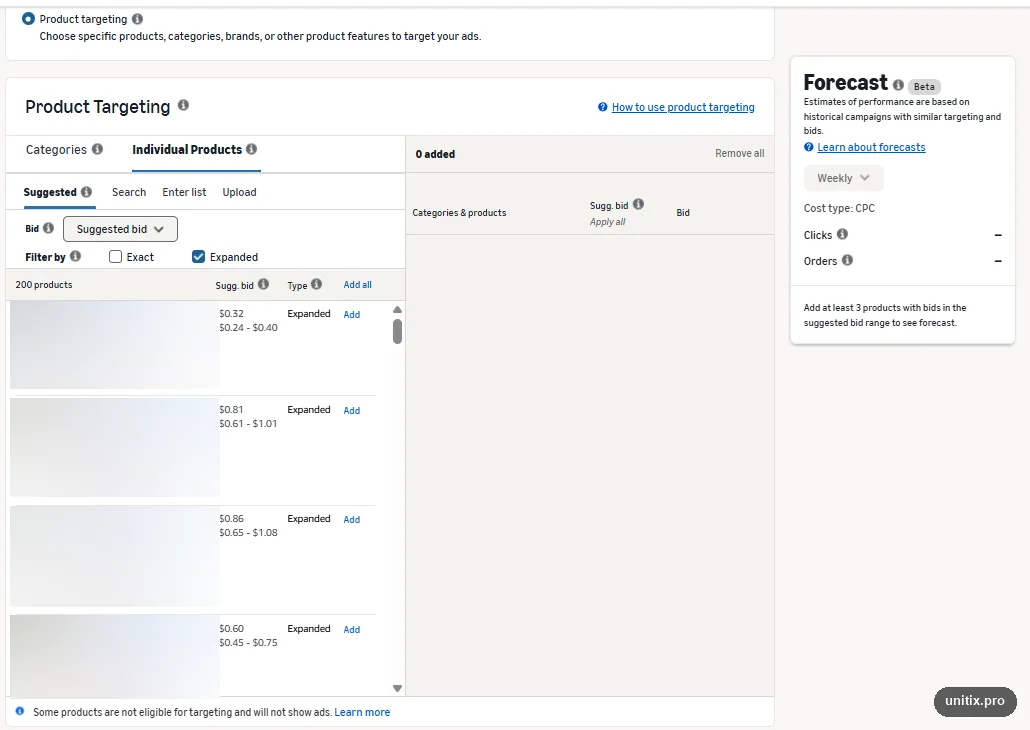
2. Only Amazon lets you bid on a competitor's product. Amazon Sponsored Products can target an individual ASIN, a category or a brand. Walmart Sponsored Products is built around items and keywords and has no standard product targeting.
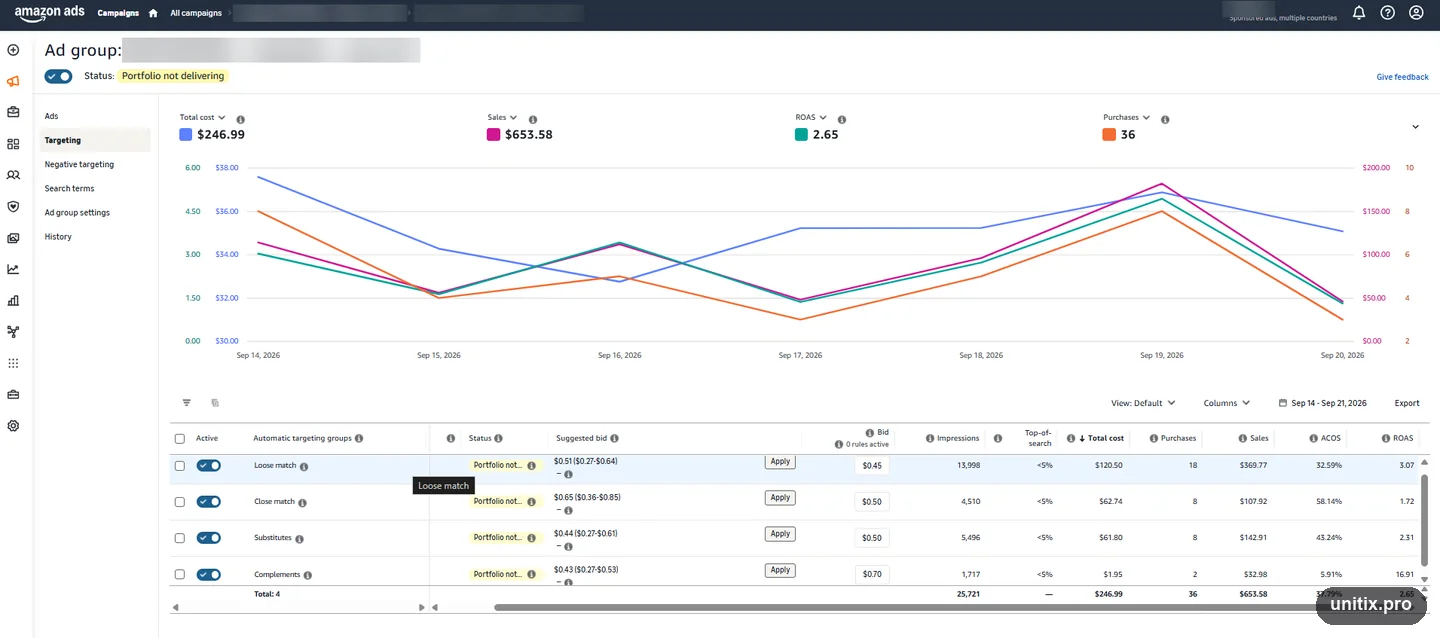
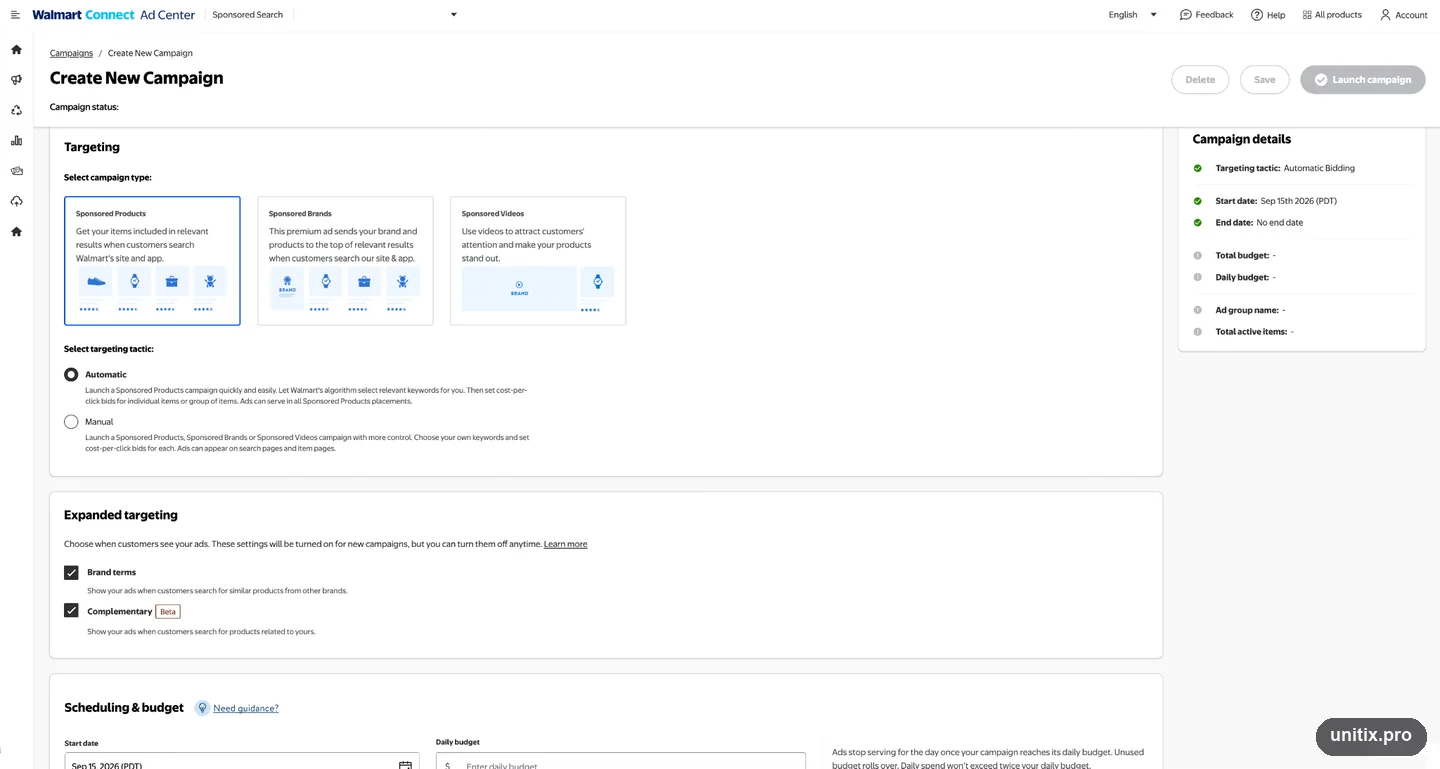
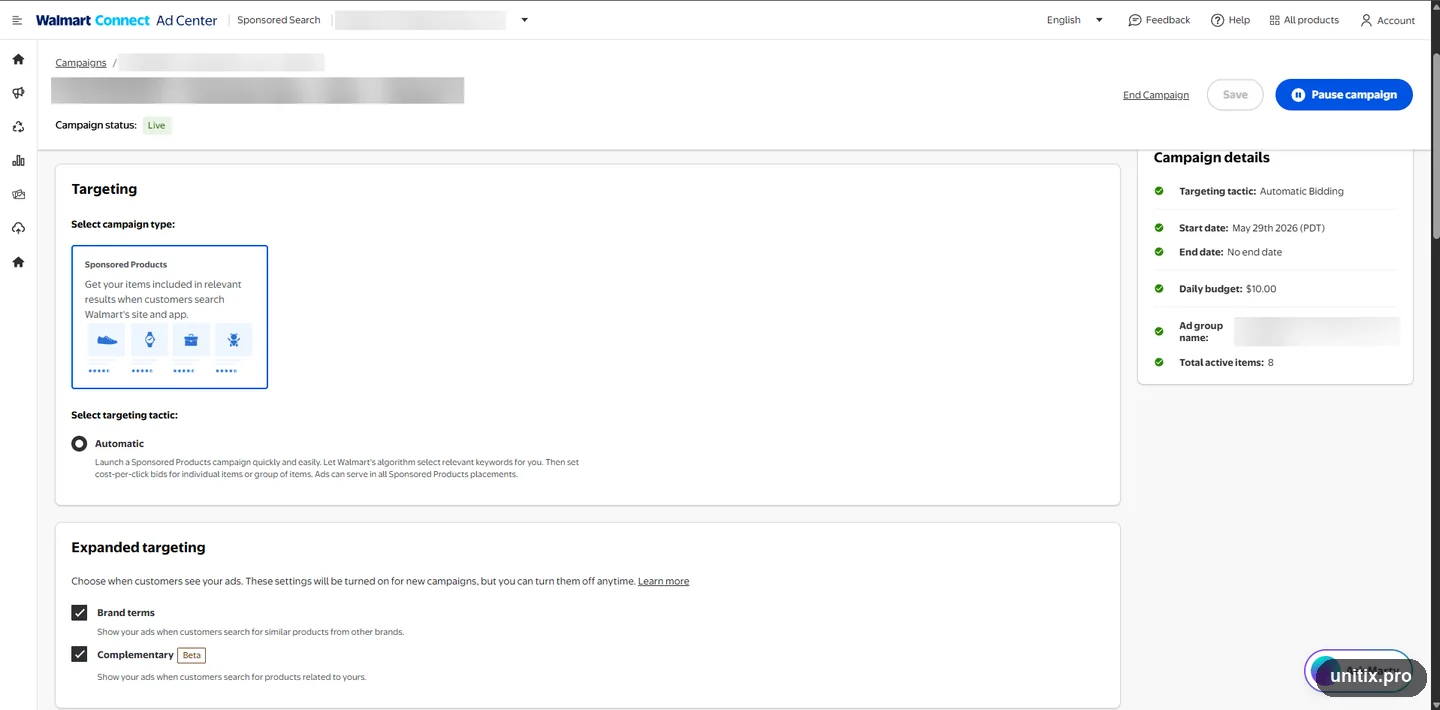
3. Amazon prices automatic targeting in four parts, Walmart in one. Amazon splits automatic campaigns into close match, loose match, substitutes and complements, each with its own bid and its own reporting. Walmart gives brand term targeting and complementary product targeting as two switches on the campaign.
4. On Walmart, negative keywords depend on the bidding strategy. Walmart Connect supports negative keywords in manual Sponsored Products, and in automatic Sponsored Products only when the campaign uses fixed bidding. Amazon has no such condition.
5. Only Walmart lets you bid differently by device. Walmart Connect supports platform bid multipliers for desktop, app and mobile web. Amazon Ads offers no equivalent adjustment.
6. Only Walmart publishes a minimum bid. Walmart's documented floors are $0.20 for automatic Sponsored Products, $0.30 for keyword bid Sponsored Products and $0.50 per match type for Sponsored Brands and Sponsored Videos. Amazon publishes no single minimum across Sponsored Ads.
7. Search terms sit in the campaign on Amazon and in a report on Walmart. Amazon shows the phrases shoppers typed inside the campaign manager. On Walmart the Item Keyword Performance report is what ties an item to a keyword to a result, so the analysis is an export rather than a screen.
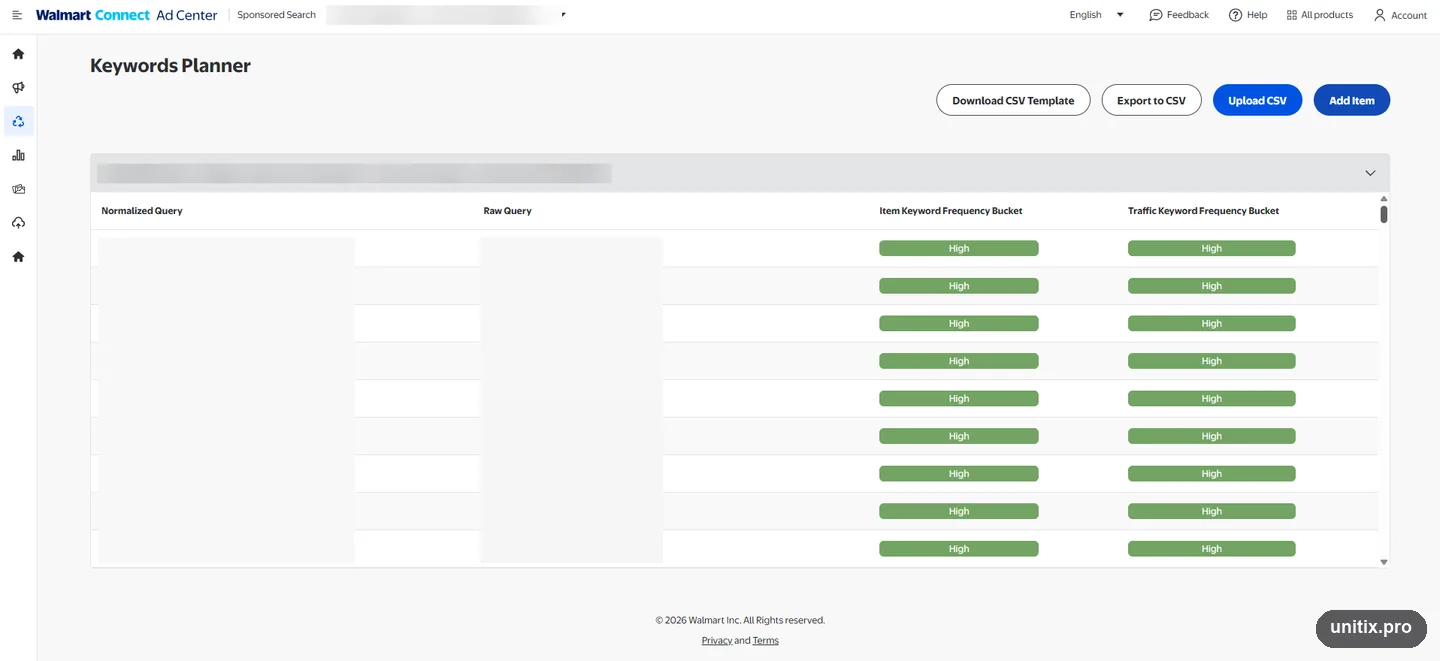
8. Walmart has a keyword planner, Amazon does not. Walmart Connect includes a Keywords Planner that returns queries tied to a specific item with frequency buckets. Amazon offers keyword recommendations inside campaign creation but no standalone equivalent in the standard console.
9. Walmart is a day behind. The most recent complete day in a Walmart Connect account is the day before yesterday, and it keeps filling in as attributed orders land. Amazon backfills conversions too, but yesterday is there.
10. The attribution windows are not the same. Walmart offers 3, 14 and 30 day windows, with 14 days as the default in Ad Center. Amazon's window depends on the ad product, the advertiser type and the report, so the same ROAS on the two platforms is not the same result.
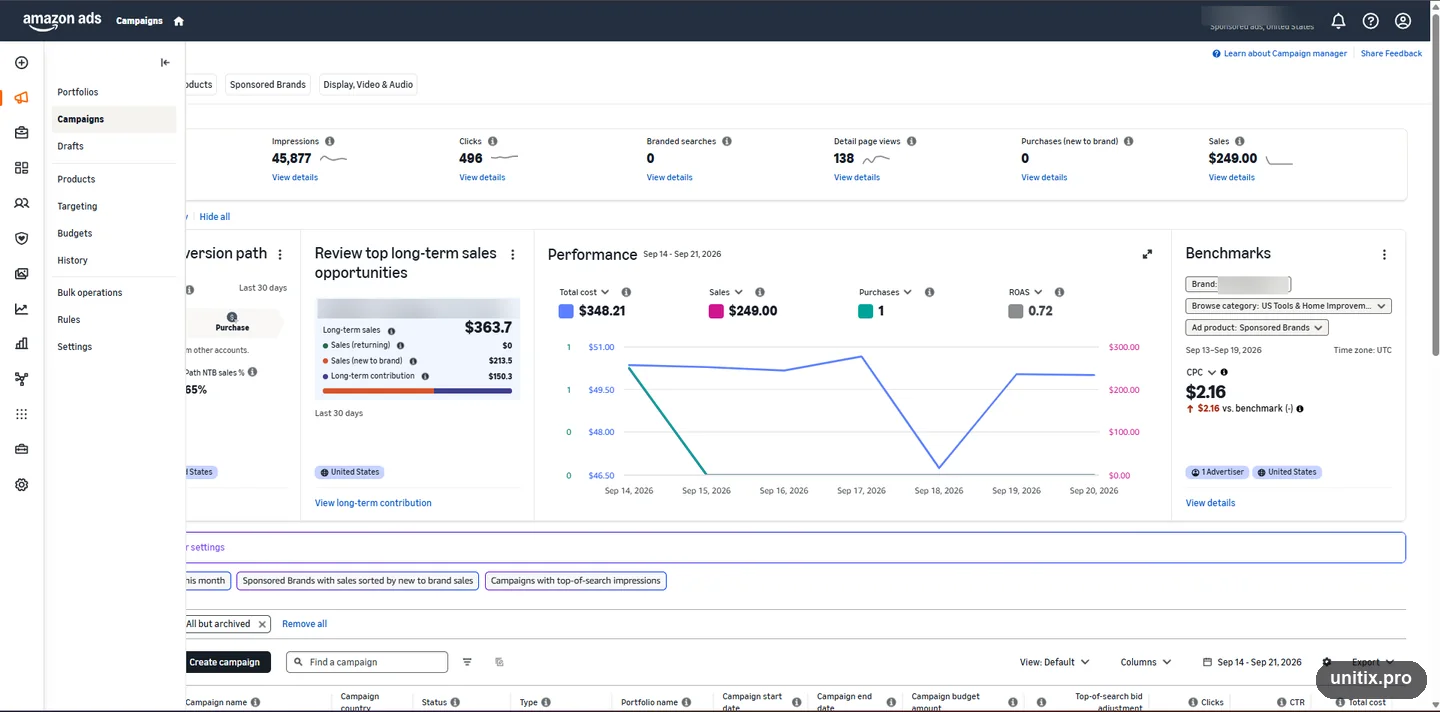
1. The account is a deeper tree on Amazon
Amazon Ads nests more levels than Walmart Connect, and those levels are where analysis happens.
A Sponsored Products account on Amazon runs: advertising account, portfolio, campaign, ad group, advertised products, then keywords or product targets, then search terms and placements.
Walmart Connect runs: advertiser account, campaign, ad group, items, then keywords or automatic targeting controls, then search terms, placements and platforms.
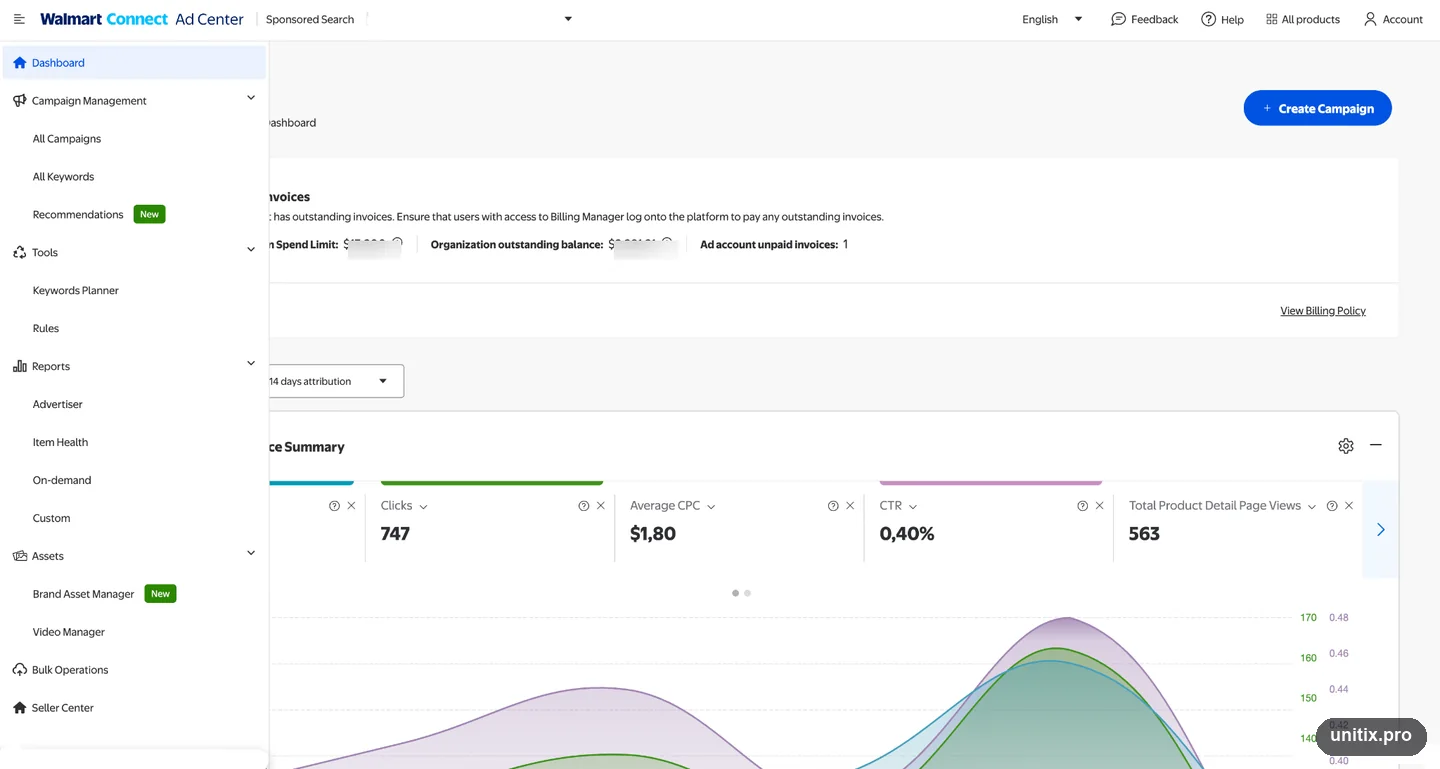
The missing level is the portfolio. On Amazon a portfolio groups campaigns by brand, category, product line or season, and can carry its own budget cap on top of the daily campaign budgets. Walmart has no equivalent. Campaigns arrive as one flat list, so any grouping has to be built out of a naming convention, filters and exports. That is not a cosmetic difference. On Walmart, a sloppy campaign name is the thing that later stops you from answering a simple question about a brand or a product line.
The second structural difference is what a row in a report actually means. Amazon keeps three objects apart: the advertised product (the ASIN being promoted), the target (the keyword, category or ASIN you bid on), and the search term (what the shopper typed). When a result moves, that split is what tells you which of the three caused it.
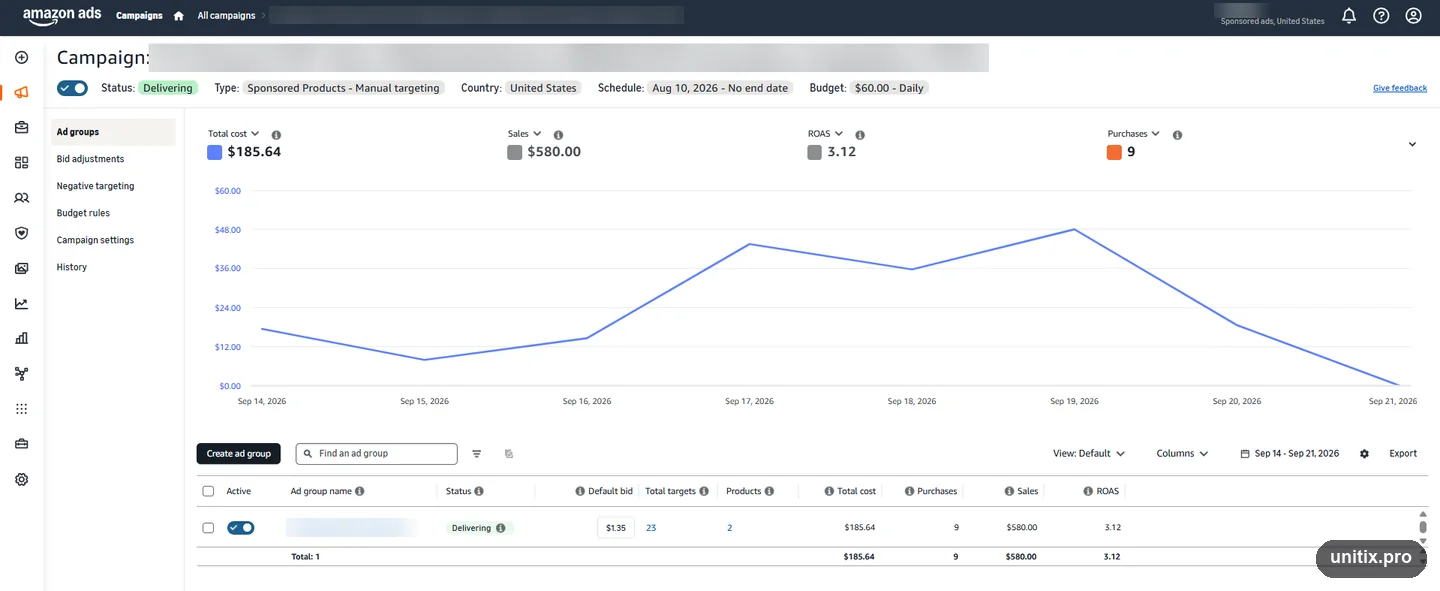
Inside a Walmart campaign, the work is mostly settings, bids and the items being advertised. Performance detail lives in the reports section rather than in the campaign, so item level and keyword level questions are answered by an export.
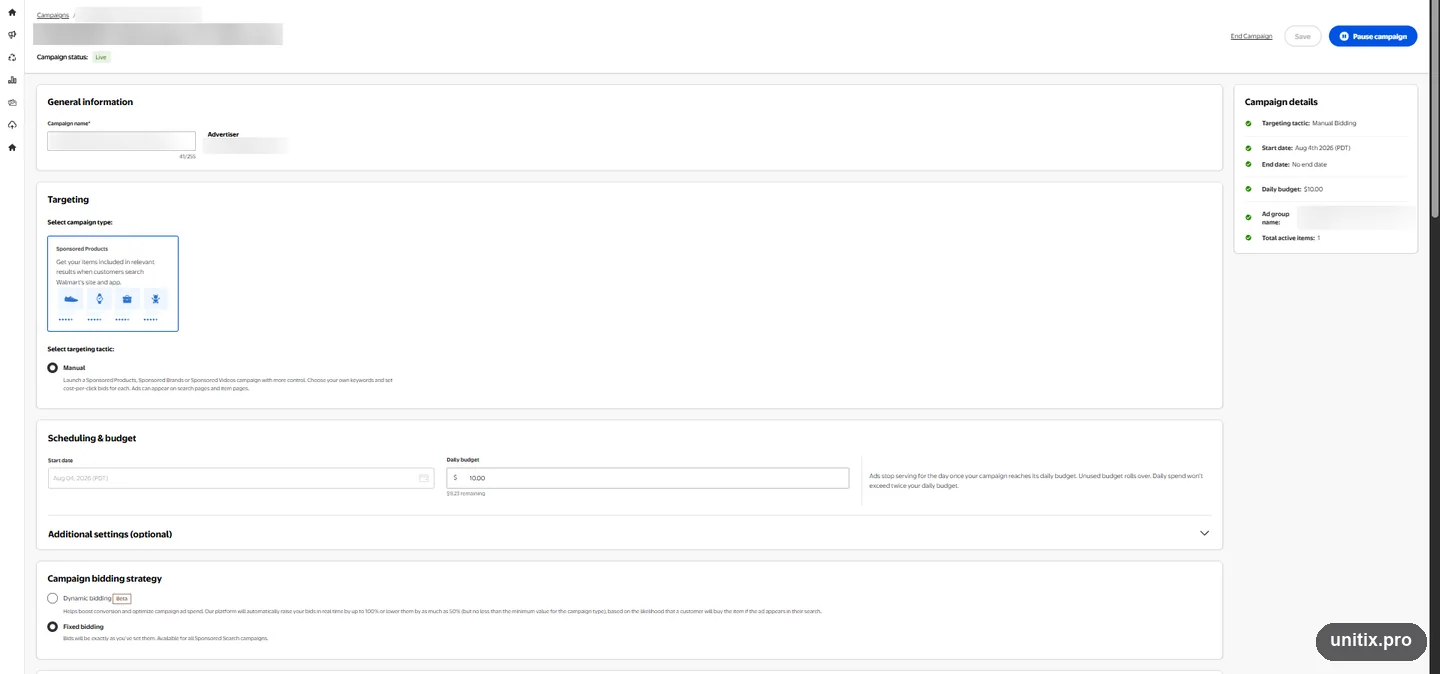
2. The campaign types line up, the contents do not
Both platforms sell the same three ideas: promote a product, promote a brand, buy display. What sits inside each one is different.
Amazon presents Sponsored Products, Sponsored Brands, and Display, Video and Audio in a single console, with Full Funnel Campaigns in beta alongside them.
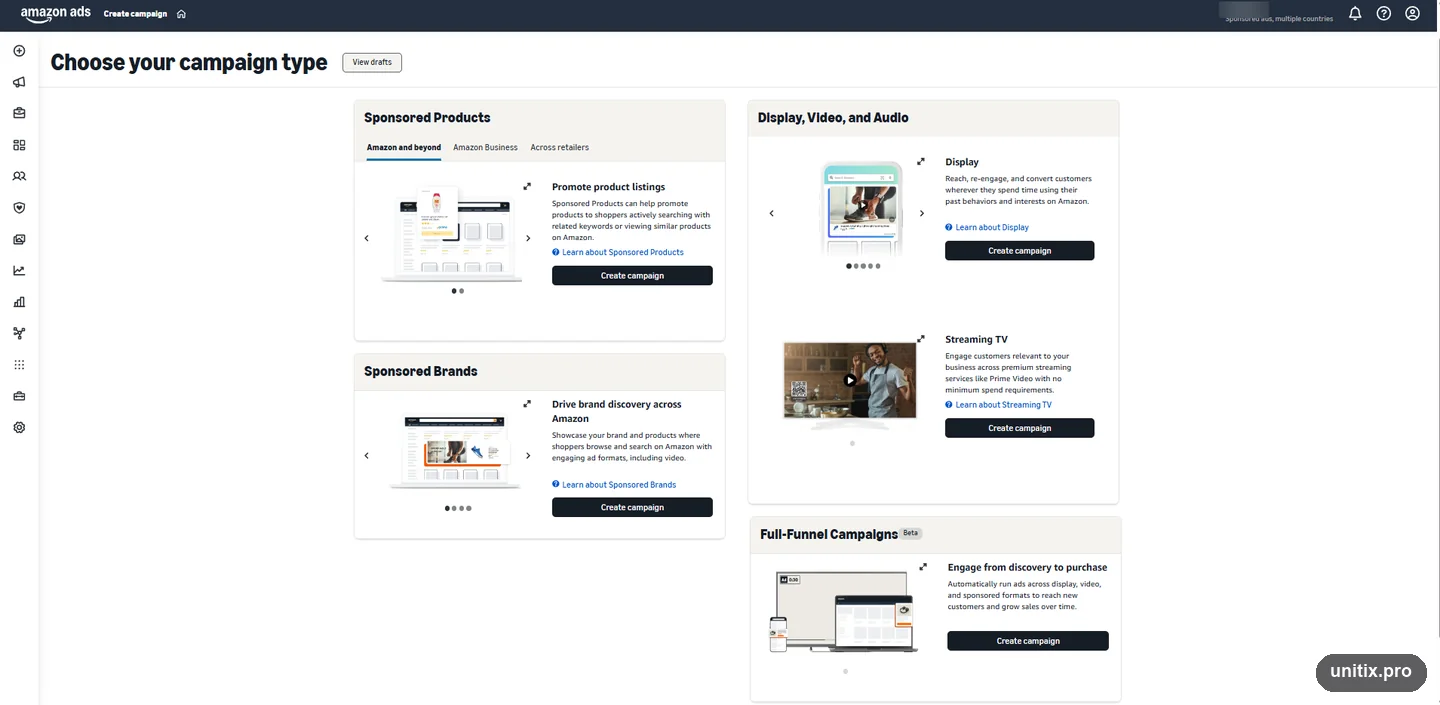
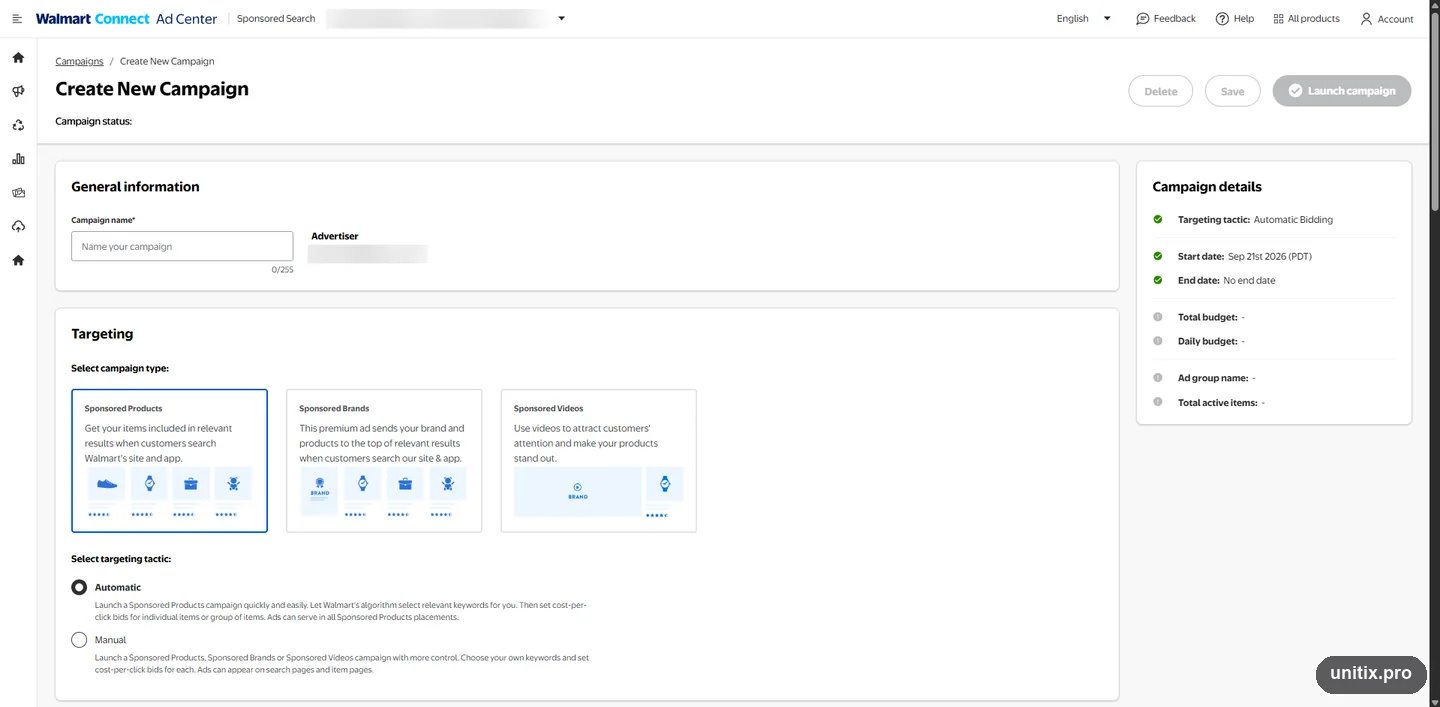
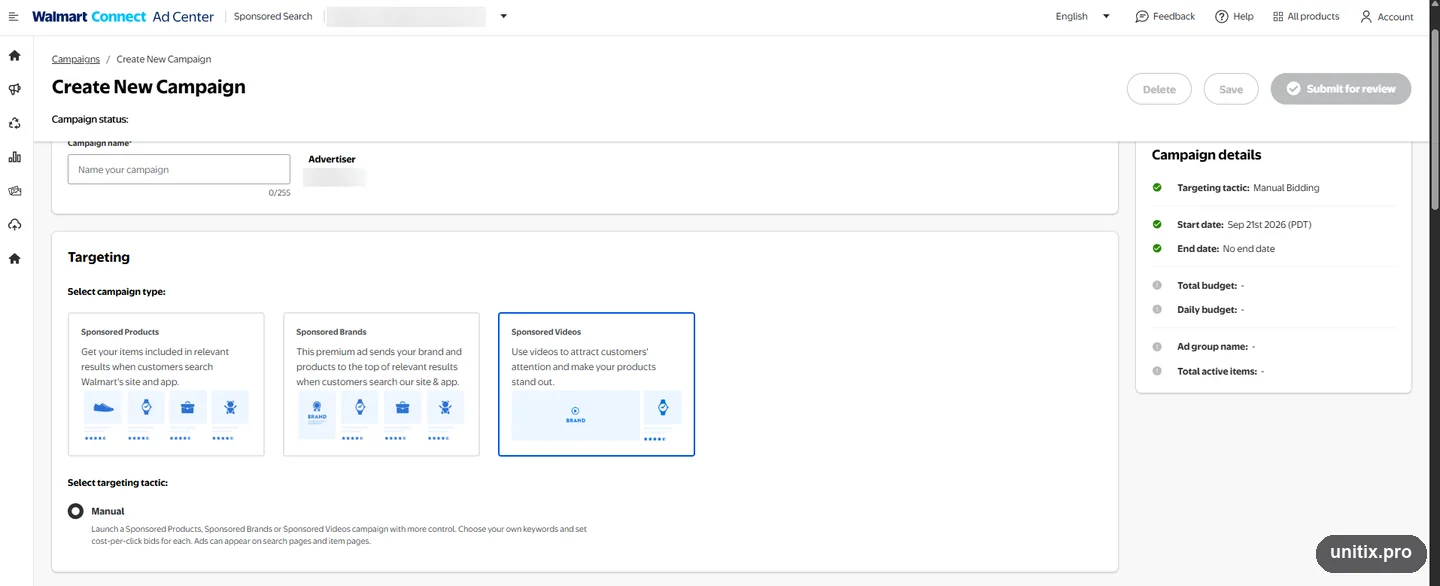
Walmart Sponsored Search offers three: Sponsored Products, Sponsored Brands, Sponsored Videos. Video is its own campaign type here, not a format inside the brand campaign.
Automatic campaigns. Amazon splits its automatic targeting into four groups that exist as separate objects: close match, loose match, substitutes and complements. Each takes its own bid and reports its own result, which is why an automatic campaign on Amazon doubles as a research tool for the manual ones.
Walmart's automatic campaigns hand matching to the algorithm and give you two switches instead: brand term targeting, which extends the campaign onto searches connected to your brand, and complementary product targeting, for products shoppers buy alongside yours.
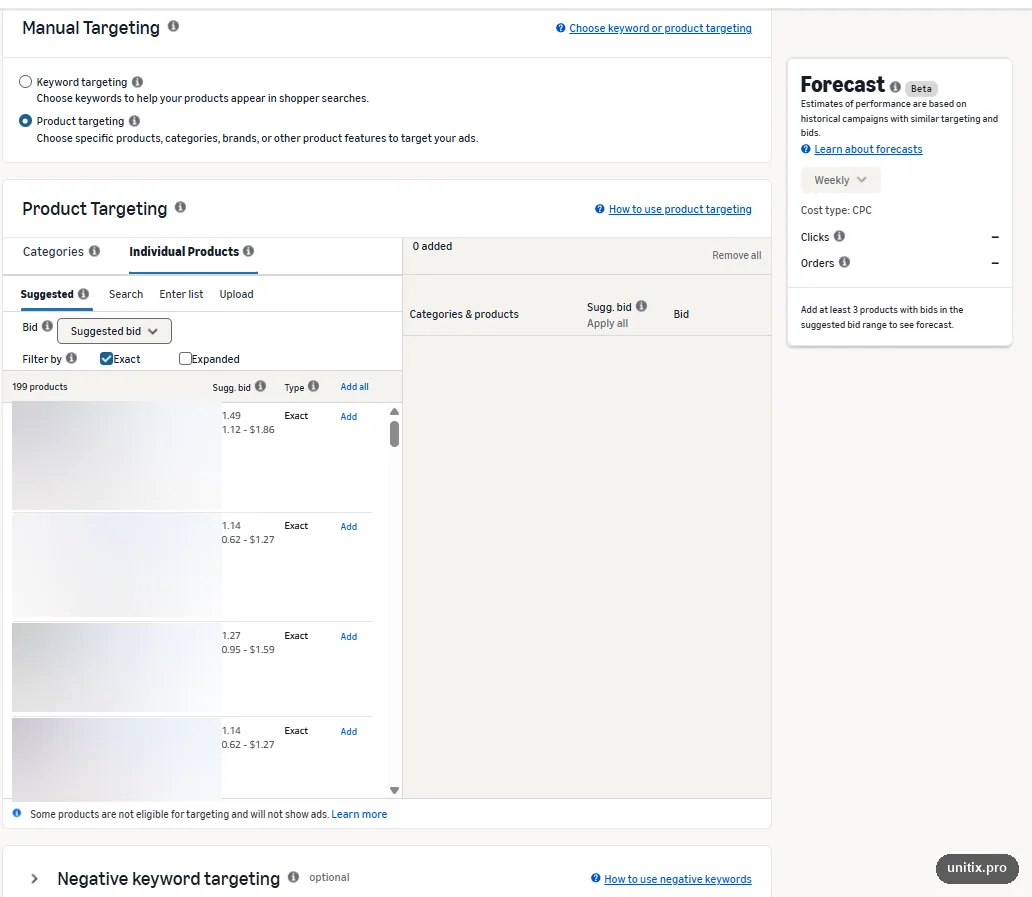
Manual campaigns. This is the widest gap in the whole comparison. Amazon manual targeting comes in two kinds. Keyword targeting works on broad, phrase and exact. Product targeting bids on the product context instead of the search: individual ASINs, whole categories, or brands. That is what makes competitor ASIN campaigns, category campaigns and defensive campaigns on your own listings possible.
Walmart's manual Sponsored Products workflow is built around items and keywords, with exact, phrase and broad match. There is no standard equivalent of picking a competitor's item and bidding on its page.
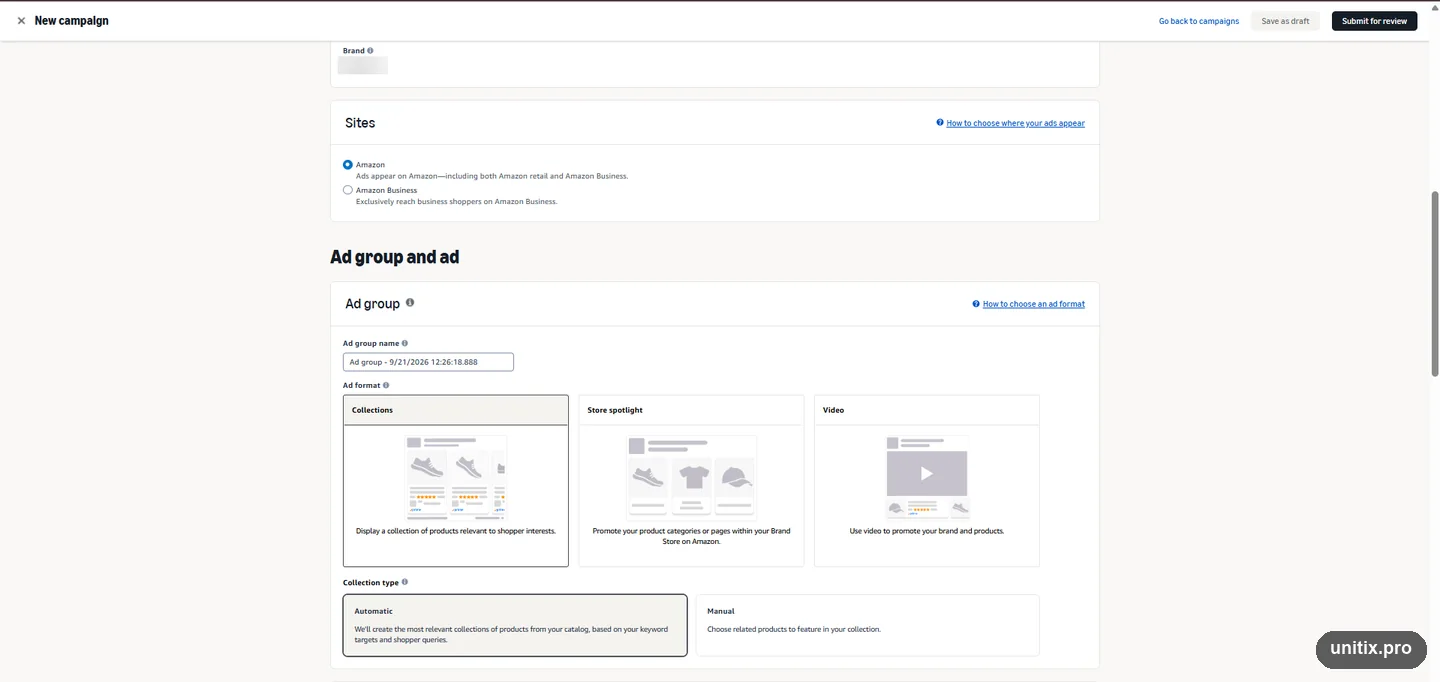
Sponsored Brands. On Amazon this is a family: collections, brand store spotlight and video, targeted by keywords, products or categories, with CPC, vCPM and a reserved share of voice option for your own branded terms. Clicks can land on a product page, the brand store, a specific store page or a landing page.
Walmart Sponsored Brands is one fixed shape: manual keyword targeting, a brand logo, a message and up to four products shown. Walmart Connect says a campaign can include up to ten items and its algorithm picks the four most relevant, that an ad group is capped at 200 keywords, that the minimum bid is $0.50 per match type, and that the click can be sent to a search results page, a product page, or a Brand Shop or Shelf. It runs on CPC only, and it is open to brand owners and authorised brand representatives rather than to every seller.
Sponsored Videos is separate: five to 45 seconds, 16:9, manual keyword targeting across all match types, CPC, appearing in the search grid and landing on the product page.
Display. Amazon Display sits in the same console as everything else. It offers audience targeting, contextual targeting, views and purchases remarketing, automatically generated ecommerce creative built from the product page, custom images and video, and it runs on CPC or vCPM.
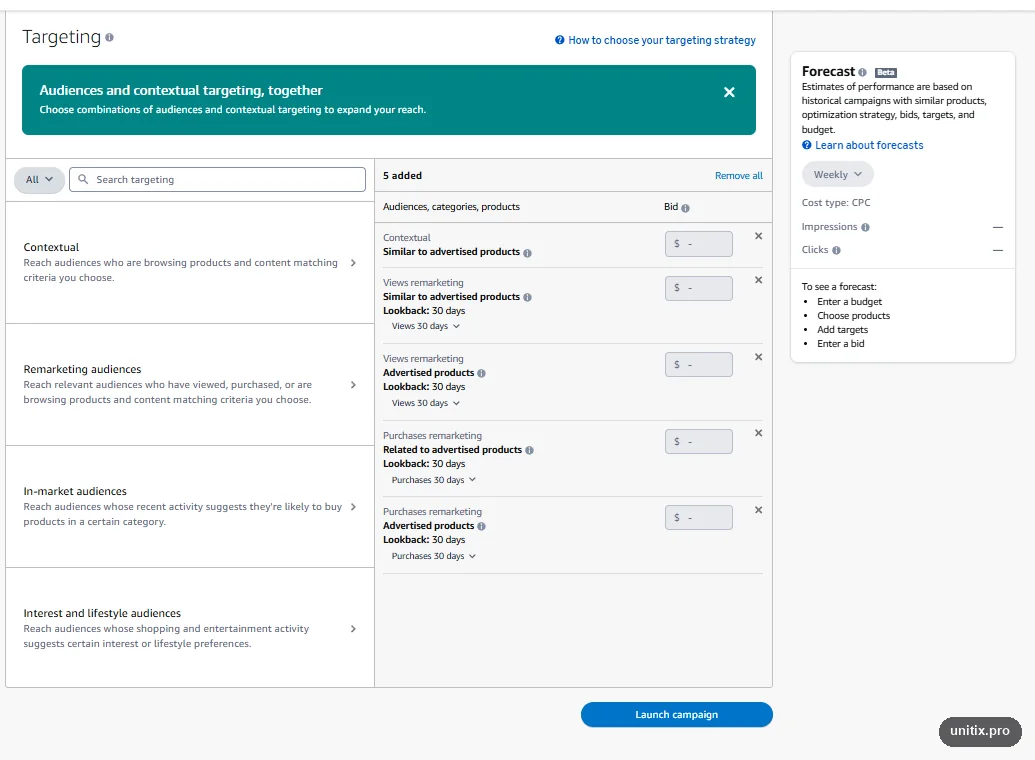
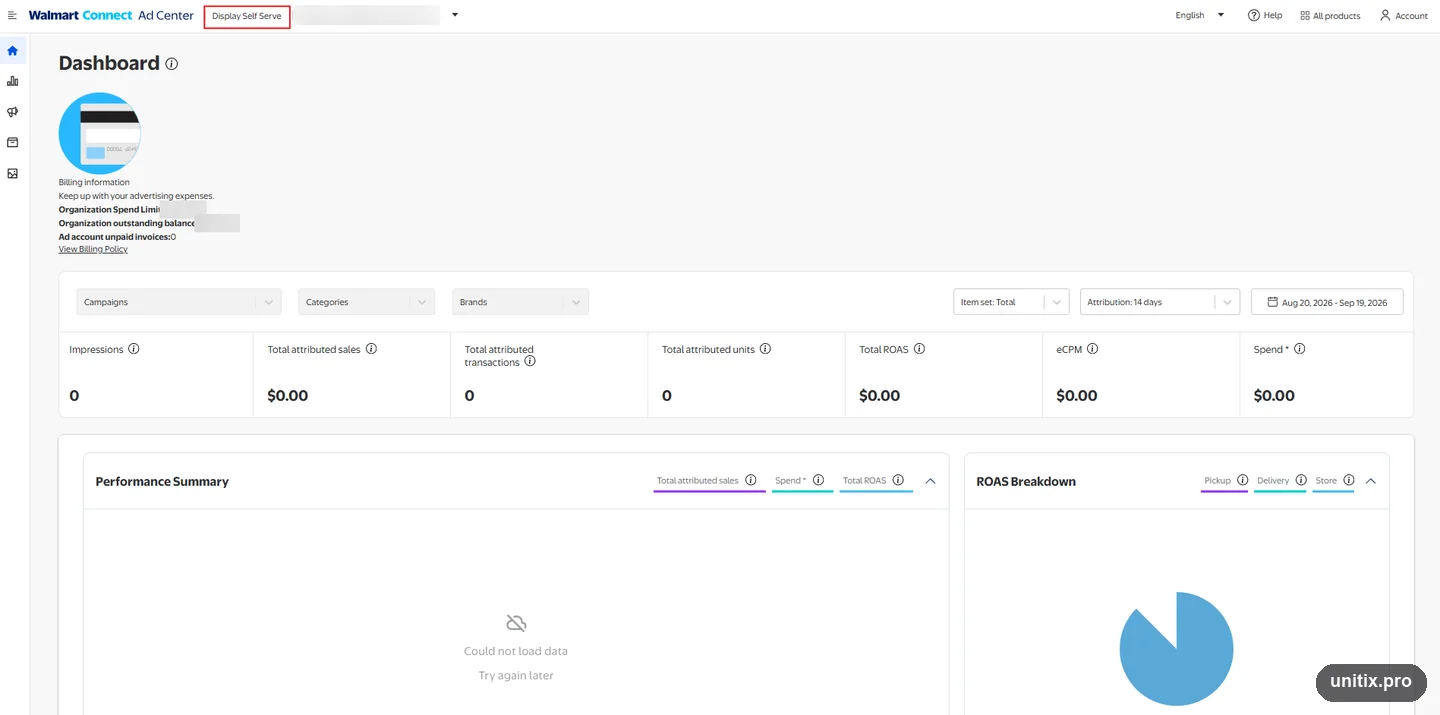
Walmart Onsite Display is a different workspace. Display Self Serve is reached separately from Sponsored Search, and the campaign is built in a different order.
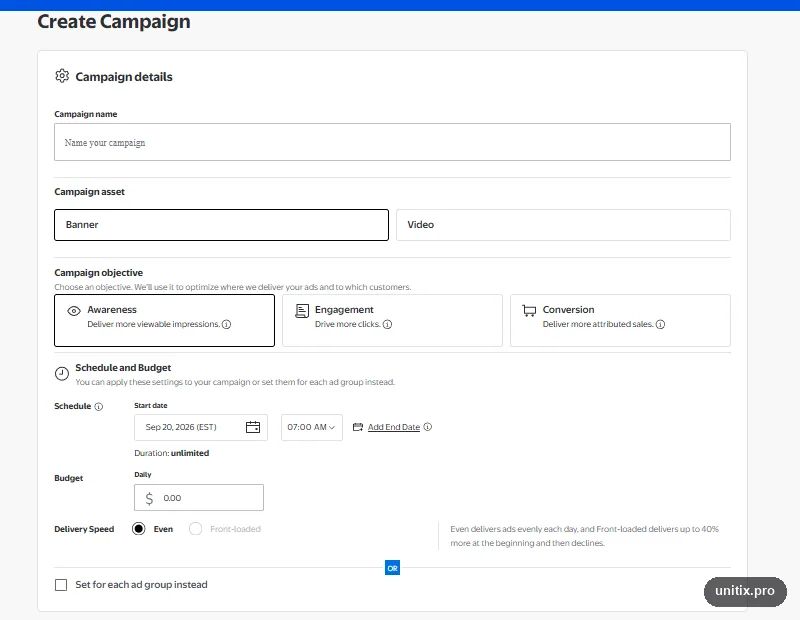
You choose the asset first, banner or video, then the objective: awareness optimises for viewable impressions, engagement for clicks, conversion for attributed sales. Then schedule and budget, and a delivery speed setting, even or front loaded. Then the part with no Amazon counterpart: featured items, which are the products in the creative, and halo items, which are the additional products whose sales Walmart will count when measuring the campaign, chosen by category, by brand, by a list you build, or not at all.
Beyond the marketplace. Amazon adds Streaming TV, audio and the Amazon DSP. Walmart adds Offsite Media, Walmart DSP and Store Ads, which are the screens and audio inside physical stores. The shape of the two ecosystems differs here: Amazon extends into its own digital properties, Walmart extends into its shops.
3. Bidding: more dials on one side, more multipliers on the other
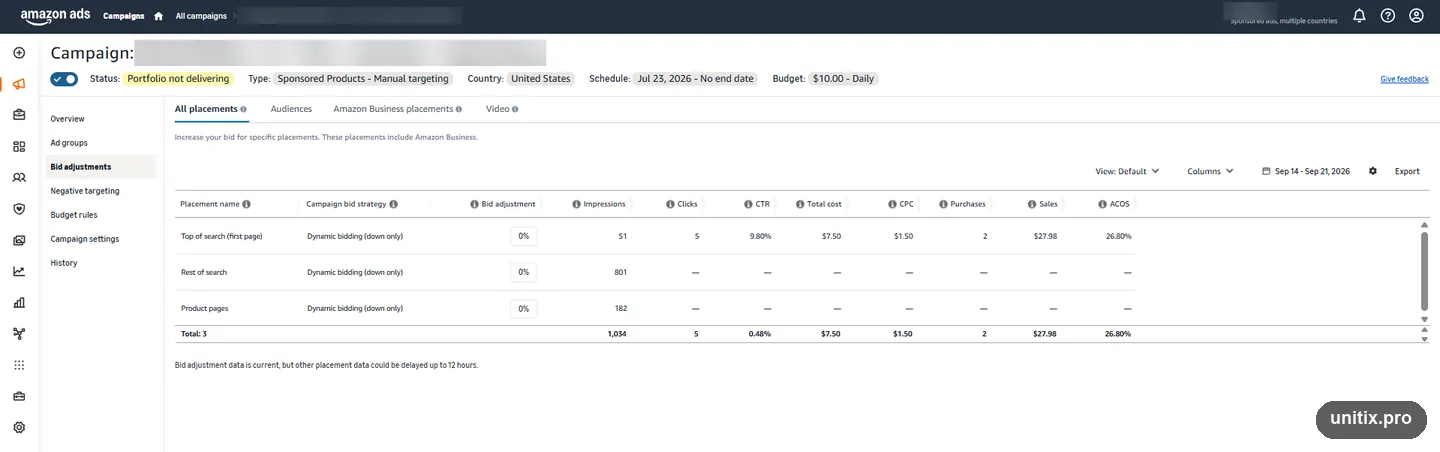
Amazon Sponsored Products offers fixed bids, dynamic bids down only, and dynamic bids up and down. Amazon's guide states that up and down can move a bid by up to 100% for all placements. On top of that sit bid adjustments by placement: top of search, rest of search and product pages, plus adjustments for audiences, Amazon Business placements and video, depending on the account.
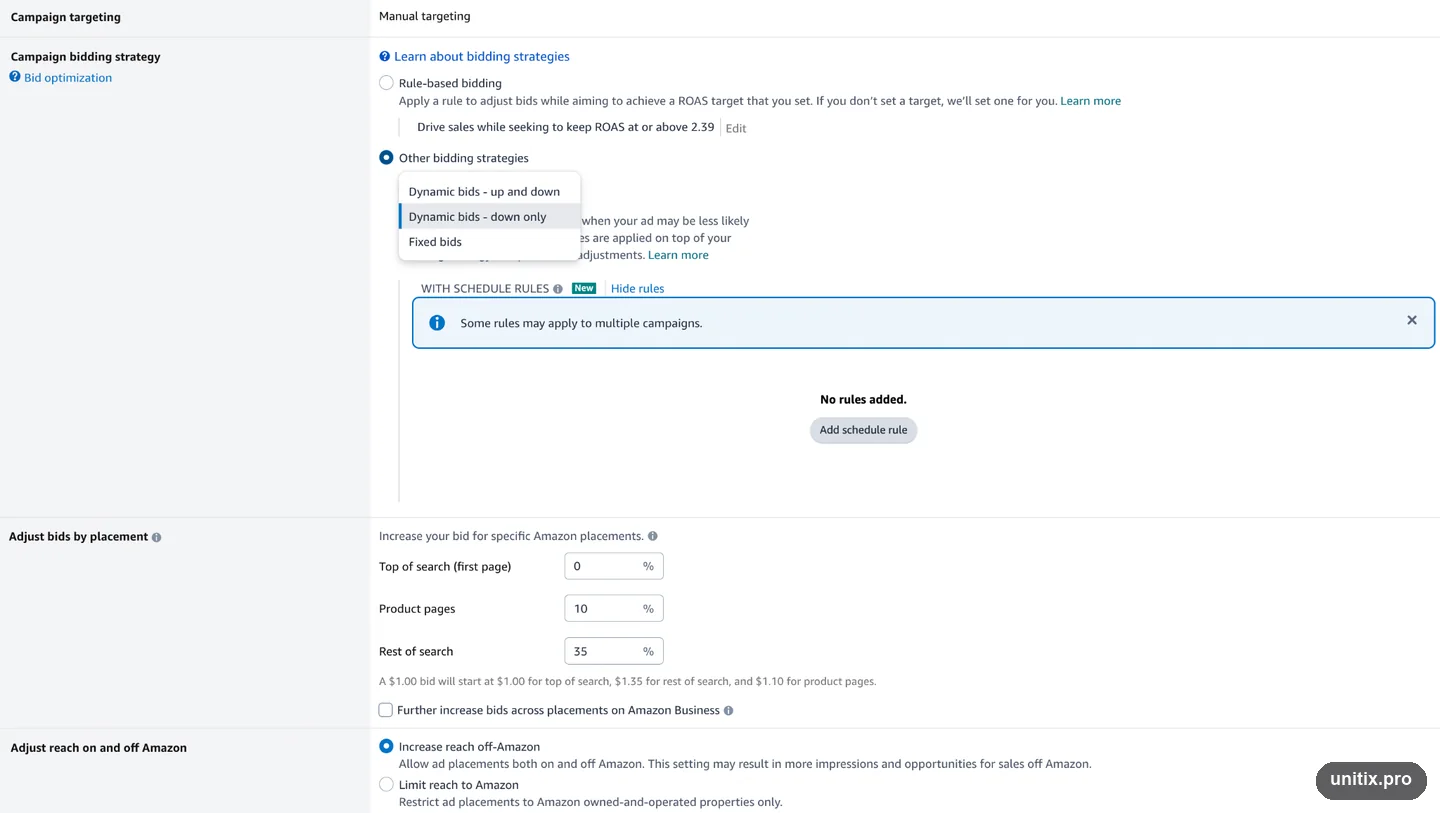
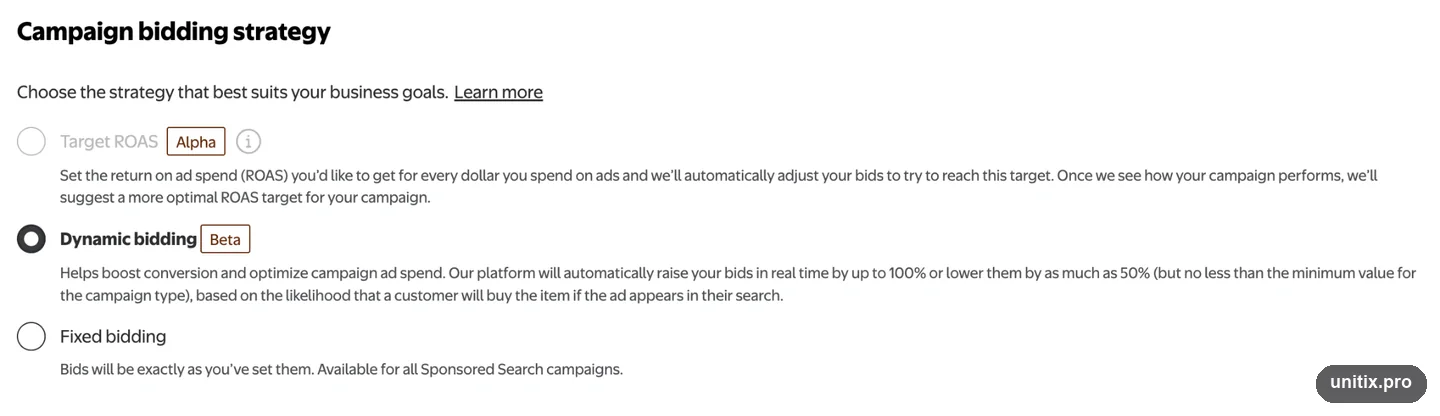
Walmart offers fixed bidding, dynamic bidding and target ROAS. Dynamic bidding is described in the interface as raising bids by up to 100% and lowering them by up to 50%, never below the campaign type's minimum. It is one setting, not two directions you can pick between.
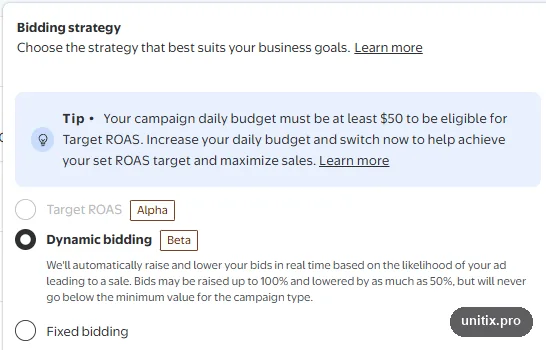
Target ROAS has an entry requirement the interface states plainly: a daily budget of at least $50. Below that the strategy is not available, which quietly rules it out for a lot of small Walmart accounts.
The adjustment layer is where the platforms swap places. Amazon reports performance per placement and lets you adjust from the same screen.
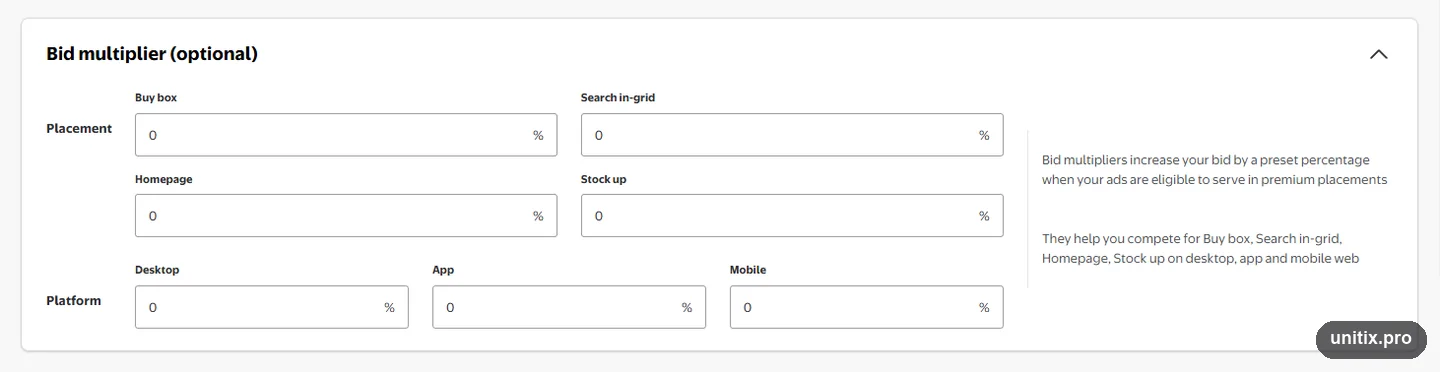
Walmart gives bid multipliers per placement, buy box, search in-grid, homepage and stock up, and something Amazon does not offer at all: platform multipliers for desktop, app and mobile web.
4. Finding what to bid on
Amazon research runs in two directions at once. Keywords come from recommended keywords at campaign creation, from search term reports, from Brand Analytics for registered brands, and from the category's own language.
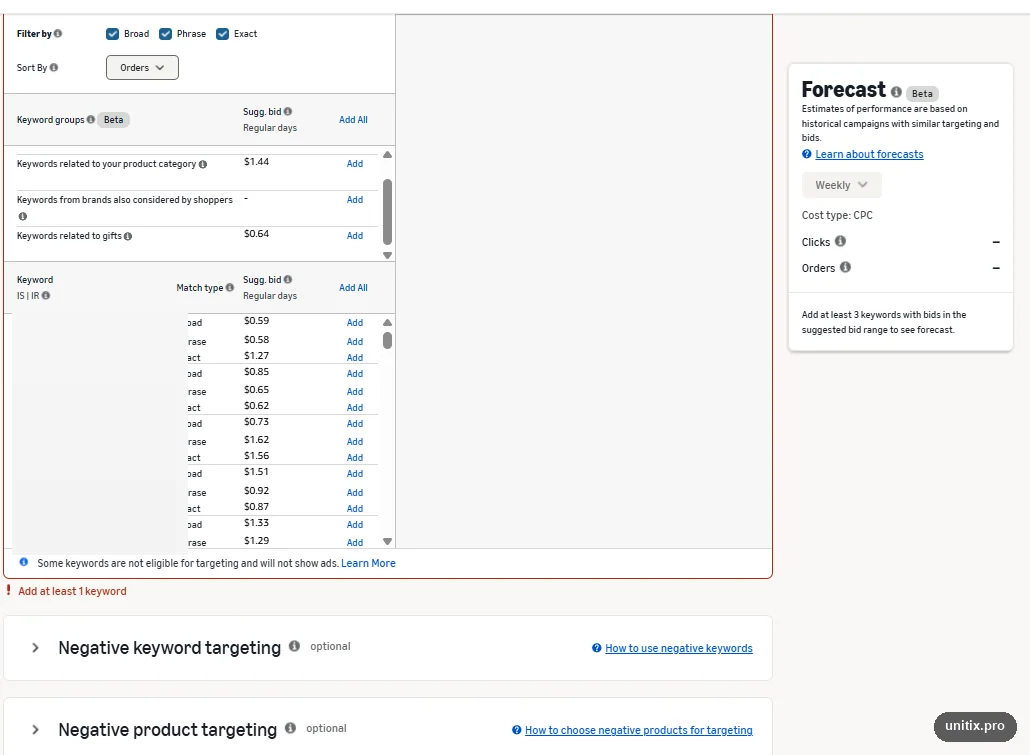
Product targets come from suggested ASINs, competitor ASINs, categories and brands. Nothing on Walmart replaces that second direction.
Walmart's answer is a tool Amazon does not have: the Keywords Planner, which returns queries tied to a specific item with frequency buckets attached.
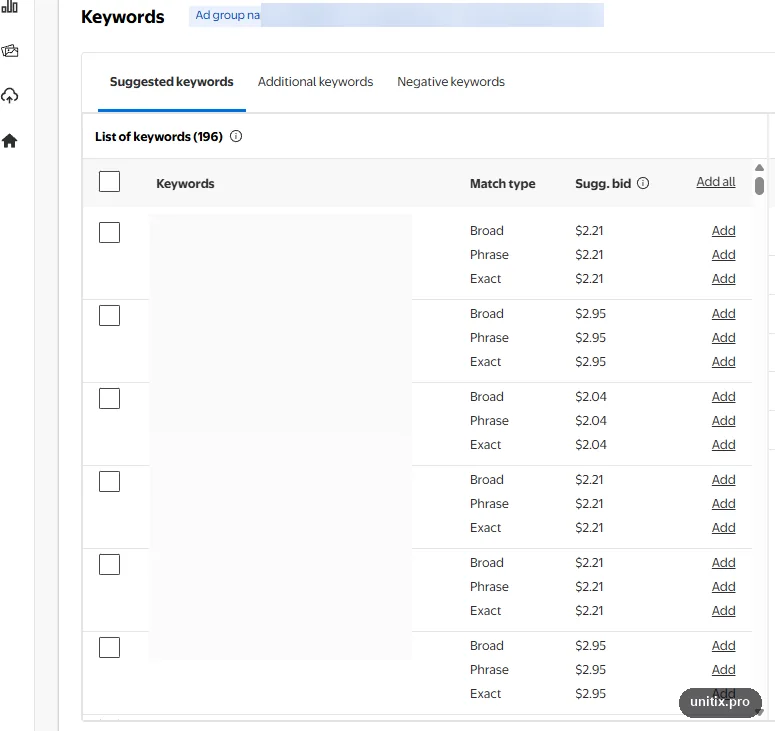
Alongside it, suggested keywords are generated from the item in the ad group, each with a suggested bid per match type.
5. Search terms and negatives
On Amazon, search terms are in the campaign manager. You read what shoppers actually typed, promote the ones that work into manual targets, and push the rest into negative targeting, which can exclude phrases, products and brands.
On Walmart, the equivalent view is an export. The Item Keyword Performance report is the one that ties an item to a keyword to a result, and for automatic campaigns it is the only way to see which queries triggered which item.
Negatives carry a condition that catches people out. Walmart supports negative keywords in manual Sponsored Products, and in automatic Sponsored Products only when the campaign uses fixed bidding. So an Amazon style negation routine cannot simply be carried over: on a Walmart automatic campaign running dynamic bidding or target ROAS, there is nowhere to put the negative until the strategy changes.
6. Reporting, attribution and the delay
The metrics match. Impressions, clicks, CTR, spend, CPC, orders, units, sales, conversion rate and ROAS mean the same things. What differs is granularity, attribution and timing, which is why the same ROAS on the two platforms is not the same result.
Amazon splits its reports by object: search term, targeting, advertised product, purchased product, placement, budget, and performance over time. The split between advertised product and purchased product is the one that shows the halo, when a click on one ASIN ends in a sale of another.
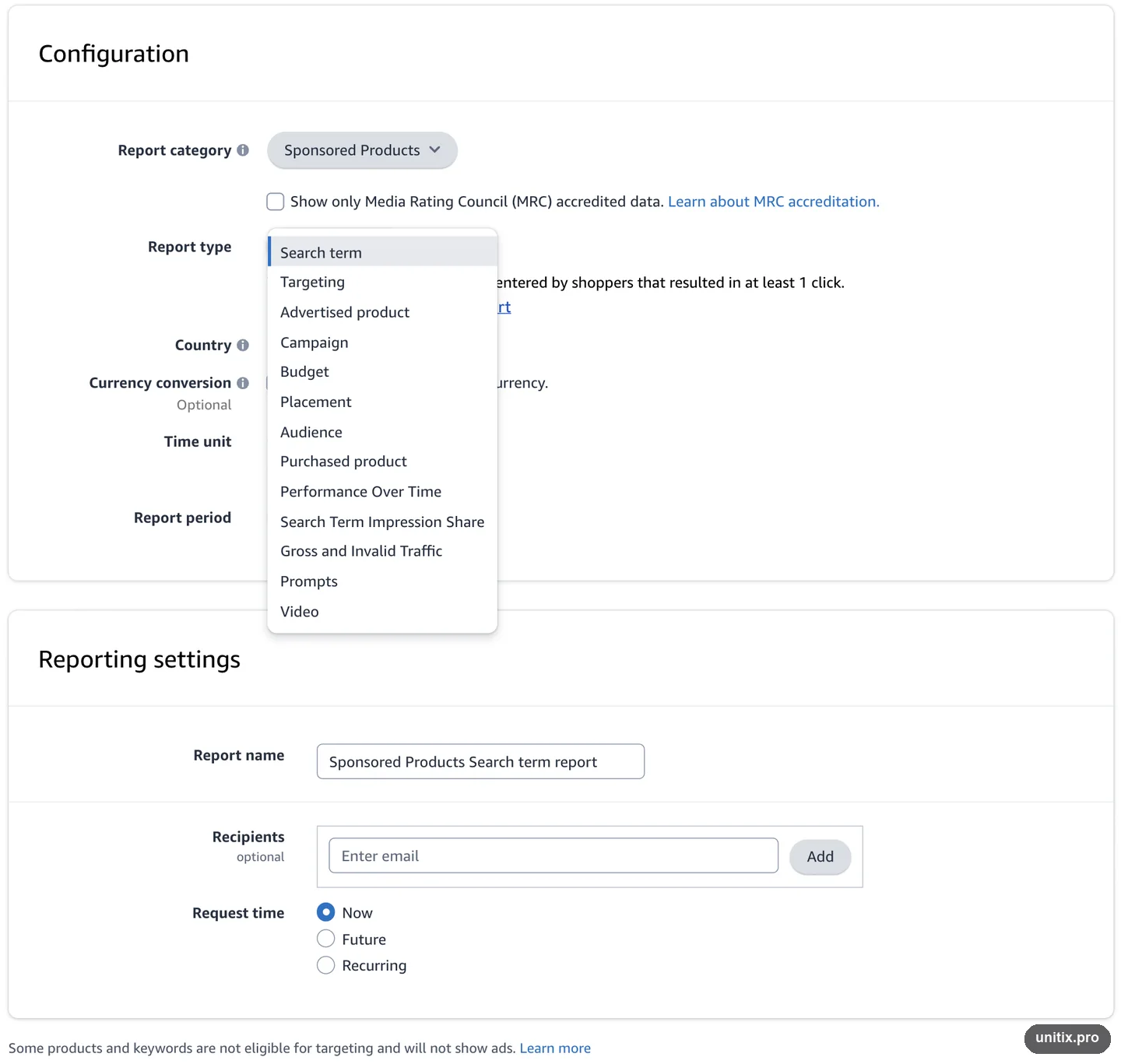
Walmart reports by campaign, ad group, item, keyword, item keyword, placement and platform, plus Item Health and search term impression share where the account has them.
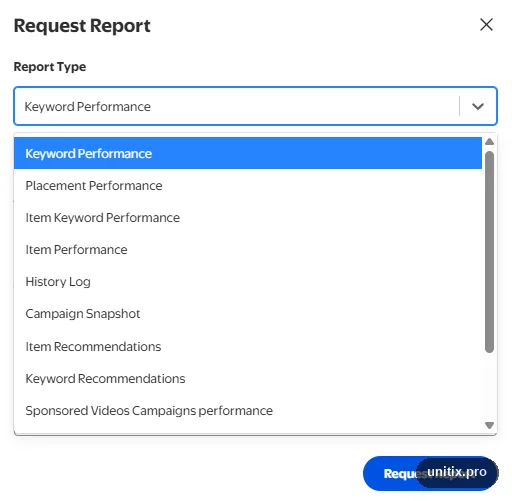
Attribution windows differ too. Walmart offers 3, 14 and 30 day windows, with 14 days as the default in Ad Center. Amazon's window depends on the ad product, the advertiser type and the report, so the metric description inside the report is the thing to read before comparing anything to anything.
Then the delay, which changes the daily routine more than any feature on this page. On Walmart you usually cannot see yesterday. The most recent complete day is the day before yesterday, and even that keeps filling in as attributed orders land inside the window. Optimising a Walmart campaign on yesterday's numbers means optimising on a partial day. Amazon backfills conversions too, so its recent days also move, but the lag does not sit in the middle of the working day the way Walmart's does.
7. Bulk operations and API access
Amazon has bulk files for creating and editing campaigns in a spreadsheet, and the Amazon Ads API for reporting and campaign management, which is what the third party PPC tool market is built on.
Walmart supports bulk operations and has an advertising API, but access depends on the partner status attached to the account. Reporting only access returns data without campaign management. Full service partner access includes both. Worth confirming before anyone plans an automation on top of it.
What Amazon PPC managers get wrong on Walmart
Most of an Amazon plan ports across. These parts do not.
Five things do not transfer
Portfolios
There is nothing to group Walmart campaigns with except their names, so the naming convention has to be decided before the first campaign, not after the fortieth.
Product targeting
Competitor and category campaigns have no standard Walmart equivalent in Sponsored Products. That share of the Amazon plan has to be replaced, usually by keyword coverage and by Sponsored Brands.
Negation
Check the bidding strategy before writing negatives into an automatic Walmart campaign, because fixed bidding is the condition for having them at all.
The daily read
A Walmart account judged on yesterday is judged on an incomplete day. The last closed period is the one to act on.
The analysis surface
On Amazon most of it is in the campaign. On Walmart most of it is in an export, so reporting has to be scheduled rather than improvised.
And two run the other way
Platform multipliers
Desktop, app and mobile web can carry different bids. Amazon has no equivalent.
Keywords Planner
Queries tied to a specific item, with frequency buckets. Nothing in the standard Amazon ads console does this.
None of this makes one platform better than the other. It makes them different accounts, run on different rhythms, which is the part that gets missed when a Walmart account is opened as a copy of an Amazon one. UNITIX Agency runs both for the same brands, with the Walmart side structured for Walmart's mechanics rather than inherited from the Amazon plan, and the Amazon side using the depth that only exists there. What that looks like on a real Walmart account, including what we found when we opened it, is written up in this case study.
Sources
- Amazon selling plans and referral fees: sell.amazon.com/pricing
- Amazon Global Selling stores: sell.amazon.com/global-selling
- Amazon dynamic bidding: advertising.amazon.com
- Amazon Sponsored Products targeting: advertising.amazon.com
- Walmart Marketplace pricing and referral fees: marketplace.walmart.com/pricing
- Walmart Marketplace seller requirements: marketplace.walmart.com
- Walmart Connect Sponsored Brands: walmartconnect.com
- Walmart Connect Sponsored Videos: walmartconnect.com
- Walmart Connect keywords and minimum bids: walmartconnect.ca advertising help
- Walmart advertising API, negative keywords and minimum bids: developer.walmart.com
Interfaces change, and several settings above depend on the marketplace, the advertiser type and what an individual account has been granted. Where a number matters to a decision, check it in the account before acting on it.
One recent addition worth knowing about either way: Walmart Connect is rolling out its own AI assistant, Marty, inside the Sponsored Search console.
Common questions
Is advertising on Walmart cheaper than on Amazon?
Not as a rule. The marketplace account is cheaper to hold, because Walmart charges no setup or monthly fee while Amazon's Professional plan is $39.99 a month. The advertising itself is an auction on both, so the cost per click follows the category and the competition in it, not the platform. What Walmart does publish, and Amazon does not, is a floor: $0.20 for automatic Sponsored Products, $0.30 for keyword Sponsored Products, and $0.50 for Sponsored Brands and Sponsored Videos.
Can I copy my Amazon campaign structure across to Walmart?
Not directly. Walmart has no portfolio level, so campaigns arrive as one flat list and the naming convention has to carry the grouping. It has no standard product targeting in Sponsored Products, so competitor and category campaigns have no direct equivalent. And negative keywords are available in automatic Sponsored Products only when the campaign uses fixed bidding.
Does Walmart Connect have product targeting like Amazon?
No standard equivalent in Sponsored Products. Amazon lets you bid on an individual ASIN, a category or a brand. On Walmart the manual workflow is built around items and keywords, and the nearest controls are brand term targeting and complementary product targeting, which are switches on an automatic campaign rather than targets you choose.
Why can I not see yesterday's Walmart advertising data?
Walmart reports with a delay: in normal use the most recent complete day is the day before yesterday, and even that keeps filling in as attributed orders land inside the attribution window. Walmart offers 3, 14 and 30 day windows, with 14 days as the default in Ad Center. Judging a campaign on yesterday means judging it on a partial day, so changes should be made on the last closed period.
What are the minimum bids on Walmart Connect?
$0.20 for automatic Sponsored Products, $0.30 for keyword bid Sponsored Products, and $0.50 per match type for Sponsored Brands and Sponsored Videos. Target ROAS is a separate case: the interface requires a daily budget of at least $50 before the strategy can be selected.
Does Walmart have an equivalent of Amazon portfolios?
No. Amazon Ads has a portfolio level above the campaign, which groups campaigns by brand, category, product line or season and can carry its own budget cap. Walmart Connect has nothing above the campaign, so campaigns arrive as one flat list and any grouping has to be built from the naming convention, filters and exports.
Is Walmart Connect easier to run than Amazon Ads?
It has fewer levers, which is not the same as easier. There is less to configure, but less to diagnose with: no portfolios, no product targeting, performance detail in exports rather than in the campaign, and a reporting delay that rules out judging a campaign on yesterday. The discipline moves from configuring the account to naming it well and scheduling the reports.
Do I need a registered brand to run Sponsored Brands on Walmart?
Walmart Connect states that Sponsored Brands is available to eligible brand owners and authorised brand representatives. A campaign can include up to ten items, and Walmart's algorithm features up to four of them in the ad alongside the brand logo and message.
Published by UNITIX Agency, an Amazon growth agency and an Amazon Ads Verified Partner. More at unitix.pro/insights.
Check your own product
ASIN Inspector
Paste an ASIN or an Amazon product link. You get the price and Buy Box, rank and how it has moved, ratings, images and video, and the search terms the product is clicked on. Free, and it needs no access to your account.