
Long-tail keywords are not the open door. We measured 1.2 million of them
The standard advice is to start on rare, specific searches because the popular ones are taken. Across every search term Amazon reported in the United States for July 2026, the opposite holds: the deeper into the tail a phrase sits, the larger the share of its clicks the top three products take.
By Mariya Tkach, Head of Marketing and Growth, UNITIX Agency
See more UNITIX in Google
Add UNITIX to your Preferred Sources.
Every guide to Amazon keywords says the same thing about where to start. The head terms are taken, so go long tail: rarer phrases, more specific, less competition, cheaper clicks.
The first half is true. The second half is worth checking, because Amazon publishes enough to check it.
We pulled the whole United States search terms report for July 2026, without the rank cap most tools apply. It contains 1,221,204 phrases, down to search frequency rank 1,216,342. For each phrase, Amazon names the three products shoppers clicked most and gives each one's share of that phrase's clicks.
Add those three shares together and you have a number for how much of a search a small group already holds.
The tail is more concentrated, not less
| Search frequency rank | Phrases | Median share taken by the top three |
|---|---|---|
| 1 to 1,000 | 1,000 | 27.6% |
| 1,001 to 10,000 | 9,000 | 30.9% |
| 10,001 to 100,000 | 90,036 | 32.6% |
| 100,001 to 500,000 | 400,444 | 34.0% |
| Beyond 500,000 | 720,724 | 35.5% |
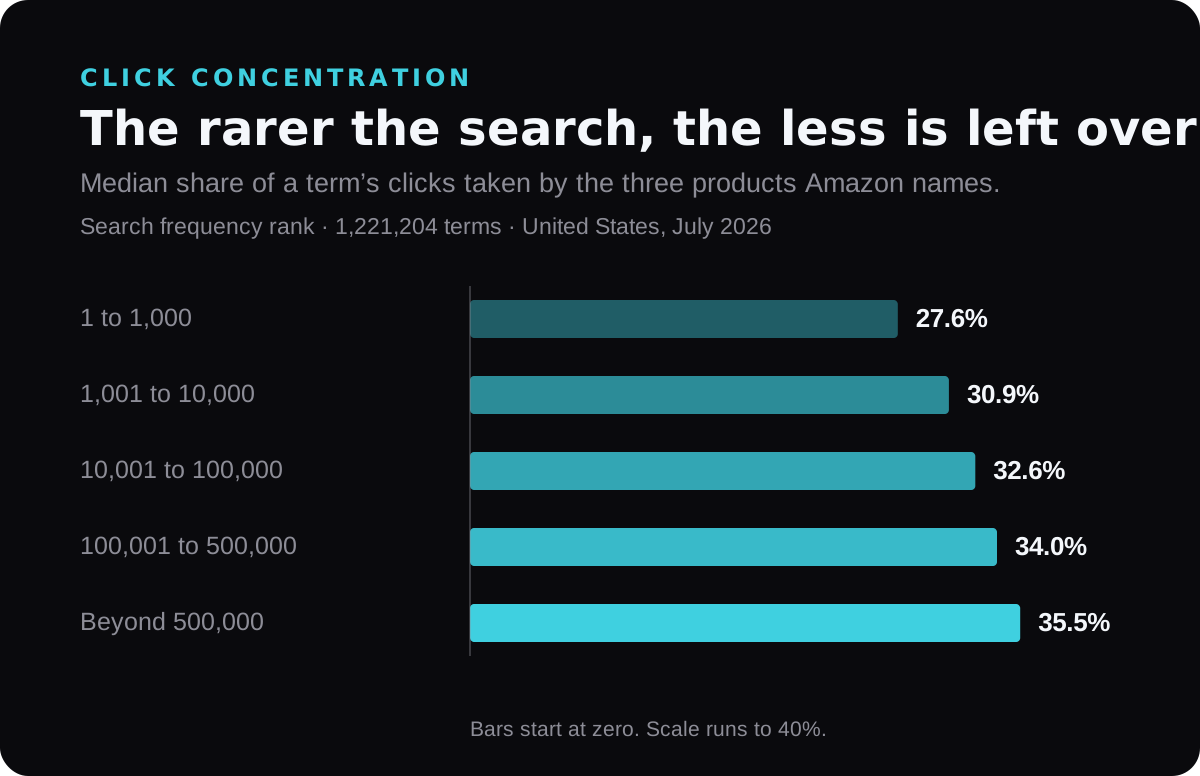
The line moves one way and it never turns. On the thousand most popular searches in the United States, the three most-clicked products take a bit over a quarter of the clicks, and everything else is spread across products Amazon does not even name. Out past rank half a million, the same three take more than a third.
That is the opposite of what "less competition" is supposed to mean.
It makes sense once it is said out loud. A rare search is rare because it is specific, and a specific search has fewer products that genuinely answer it. Attention has nowhere else to go. A broad, popular phrase pulls in dozens of products that all fit well enough, and the clicks scatter.
What competition on a phrase actually is
The word competition is doing two jobs, and separating them is the useful part.
There is how many sellers want the phrase, which is what bid prices reflect. Popular phrases cost more, and that part of the advice holds.
Then there is how much of the phrase is already spoken for. That is what the table measures, and on that measure the tail is tighter. Ranking on a rare phrase does not put you in an empty room. It puts you in a small room with three products that between them hold a third of it, and the click you want is currently going to one of them by name.
Cheaper is not the same as easier. It is entirely possible to win a cheap phrase and still be third in a room of three.
Most phrases are contested, and a tenth are settled
The averages hide the range, which matters more than the middle when you are choosing where to spend.
| How much the top three hold | Phrases | Share of all phrases |
|---|---|---|
| Under 20% | 228,739 | 18.7% |
| 20% to 50% | 649,284 | 53.2% |
| 50% to 75% | 214,370 | 17.6% |
| 75% and above | 128,811 | 10.5% |
Across the whole report the median is 34.8% and the average 40.1%. The tenth percentile is 15.4% and the ninetieth is 76.1%, which is the real story: two phrases with similar search volume can be a scramble or a closed shop, and the volume figure will not tell you which.
The 128,811 phrases in the bottom row are worth naming plainly. Ten and a half percent of everything Amazon reported is a phrase where three products take three quarters of the clicks or more. Appearing in those results does very little. There is no spare attention to collect; you would have to take it from a specific listing that is currently getting it.
The 228,739 at the top are the ones worth hunting for. Under a fifth held by the leaders means the clicks are genuinely spread, and ranking is most of the work rather than the smallest part of it.
What to do with a keyword list
Sorting by search volume is the default in every tool, and it answers a question nobody asked. Volume tells you how many people search. It says nothing about whether any of them are available to you.
Sort by what is unclaimed instead. A phrase with a fifth of the volume and a third of the concentration is usually the better target, because the ceiling on what you can take is higher.
The practical order we use on an account:
Find the phrases that are relevant, which is judgement and product knowledge, not data.
Of those, check what the top three already hold. Under 20% means ranking will do most of the work. Over 50% means you are planning an attack on a named competitor and should know whose clicks you intend to take before spending anything.
Then look at the two shares separately. Amazon reports click share and purchase share independently, and a leader who takes a sixth of the clicks and a twentieth of the purchases is winning the search and losing the page. That is a gap you can walk into with a better listing rather than a bigger budget.
Search volume comes last. It sizes the prize once you know the prize is available.
The caveats, stated plainly
This measures clicks, not sales, and the two come apart often enough that we treat them as separate diagnoses.
Amazon names exactly three products for effectively every phrase in the report: 1,220,983 of 1,221,204 have a full set of three. So "the top three" is a fixed window, not a count of how many products compete. A phrase where the top three hold 18% has plenty of other products taking clicks; the report simply does not name them.
And this is one month in one marketplace. The pattern has held across the months we hold, but the numbers here are July 2026 in the United States and nothing else.
You can run the same check on any phrase with our Amazon keyword tool: it reads this report and shows what the three named products hold, along with who they are and what they cost. The keyword tracker does the other half, which is where you currently stand on the phrases you have chosen.
Published by UNITIX Agency, an Amazon growth agency and an Amazon Ads Verified Partner. More at unitix.pro/insights.
Check your own product
ASIN Inspector
Paste an ASIN or an Amazon product link. You get the price and Buy Box, rank and how it has moved, ratings, images and video, and the search terms the product is clicked on. Free, and it needs no access to your account.