
Office Supplies
Walmart: half the ad budget, the same ad sales
A product back from a long listing block, a budget cut by more than half, and a range that sold mostly at its cheapest sizes. A year later ROAS had doubled to 4.84.
Period: September 2025 to September 2026, twelve monthsWalmart Advertising

Results
ROAS
2.44 → 4.84
↑ almost 2×
Ad spend / month
$1,672 → $798
↓ −52%
Ad sales / month
$4,075 → $3,865
−5%
Ad sales, 12 months
$53,398
Orders, 12 months
2,192
ROAS, 12 months
3.32
All changes measured against the account's first month with us, september 2025.


Run by Serhii Khyshchenko and Maxim Chistokletov.
Why no brand name. The client is under NDA. The marketplace, category, engagement window, and figures are exact; the seller is not named.
An Office Supplies seller came to us with a product that had just returned to Walmart after a long block caused by a variation problem. Sales and positions had to be rebuilt from nothing, in a category held by large brands with far more reviews.
At the start, advertising carried almost the whole business: 95% of revenue came from ads, at a ROAS of 2.44. Most of the volume came from the cheapest sizes, which had the thinnest margin, while the larger sets the client actually wanted to sell barely moved.
What a year produced
Comparing September 2025, our first month, with the latest month to September 2026:
- ROAS from 2.44 to 4.84, almost double
- Monthly ad spend from $1,672 to $798, about half. The daily budget at the start was around $75, but Walmart spent about $56 of it a day; by the end spend was about $27 a day
- Monthly ad sales from $4,075 to $3,865, nearly unchanged
- $53,398 in ad sales and 2,192 orders over the twelve months, at 3.32 ROAS overall
The brief changed twice
The original goal was to get the product selling again with efficient advertising inside a fixed budget.
In the fourth month the client added two more. The daily budget, then around $75, was to come down gradually to $20–30 a day while holding sales. And the range was to move away from the cheap variations toward the larger, more expensive sets, eventually dropping the cheap ones altogether.
Restarting after the block
The first months were for finding what worked. We launched a wide structure: automatic campaigns on different strategies and bids, broad, phrase and exact campaigns by query group, separate tests by variation size, and Sponsored Brands and Sponsored Video.
The strategy throughout was a low CPC on a fixed budget. Instead of raising bids, we covered a wide range of relevant searches at low bids, optimised weekly, and scaled only the search terms that had proven themselves. That bought more clicks and orders for the same money.
In parallel the client reworked the listings on our recommendations: titles and descriptions rewritten, content improved, Quality Score work, and a plan for collecting reviews to lift the rating.
Rebuilding around the larger sets
Once the client decided to move up the range, the listing itself had to change first. We split the original parent in two: the small, cheap sizes in one, the larger sets in the other. Each could then be advertised on its own terms.
The advertising was rebuilt around the larger sets:
- automatic campaigns split by product specification, with separate campaigns for the largest sets
- different approaches tested on different variation groups to see which paid back best
- spend on the small sets reduced step by step
- campaigns with low return switched off
With the budget shrinking, every dollar went to the campaigns and searches with the best ROAS, automatic campaigns were relaunched for the new structure, and the strong keyword campaigns were scaled.
Letting the cheap sizes go
A profitability check showed the cheap variations did not pay for themselves, neither at their price nor at a higher one. They were phased out of the Walmart range, and by June 2026 only the medium and large sets were on sale. A coupon on the larger sets supported the switch.
What it shows
Cutting ad spend does not have to cut sales in proportion. Here spend roughly halved while ad sales held, because the budget cut came together with a cleaner range, a rebuilt listing structure and campaigns that only paid for searches that converted.
For a different starting point on the same marketplace, an account that was running but had stopped growing, see the Walmart pet supplies case. How we run Walmart Connect campaigns is on the Walmart advertising page, and what changes when you move a plan over from Amazon is in Walmart vs Amazon.
The dashboard
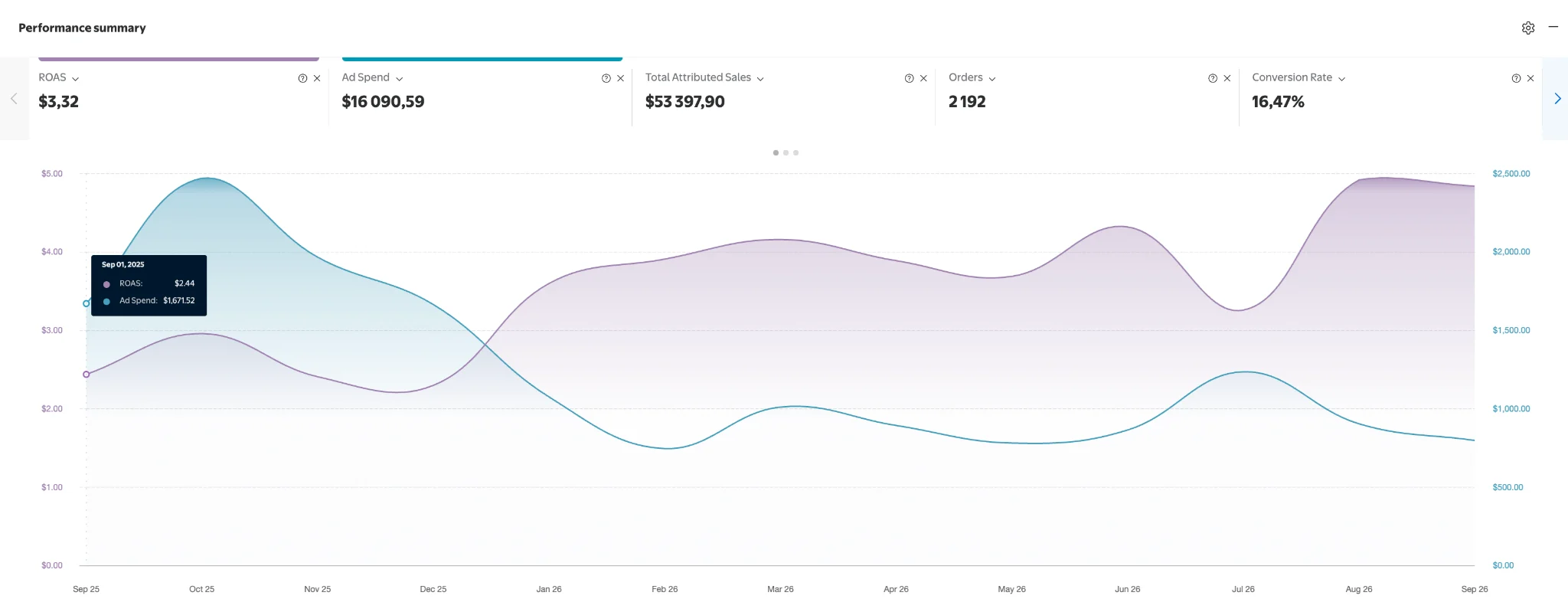
Walmart Connect, September 2025 to September 2026: ROAS and ad spend by month. The first month, September 2025, shows ROAS 2.44 on $1,671.52 of spend.Open full size 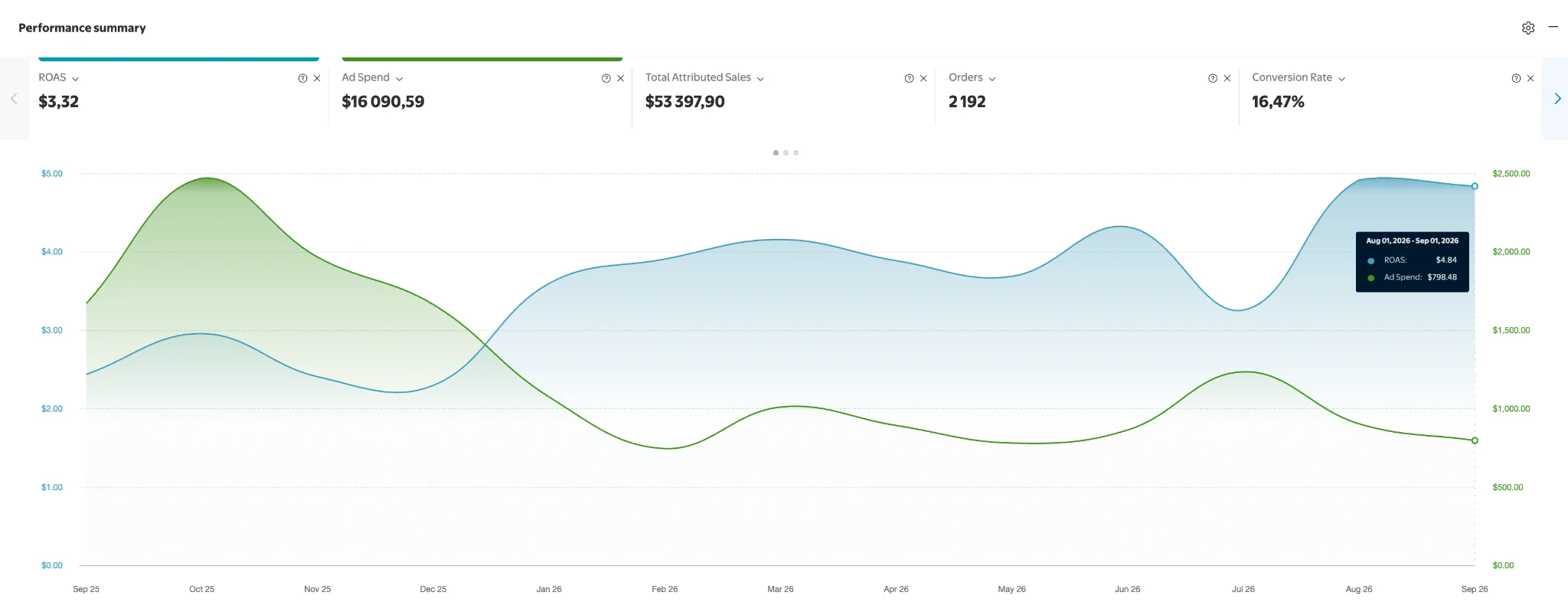
The same view at the latest month, August to September 2026: ROAS 4.84 on $798.48 of spend.Open full size 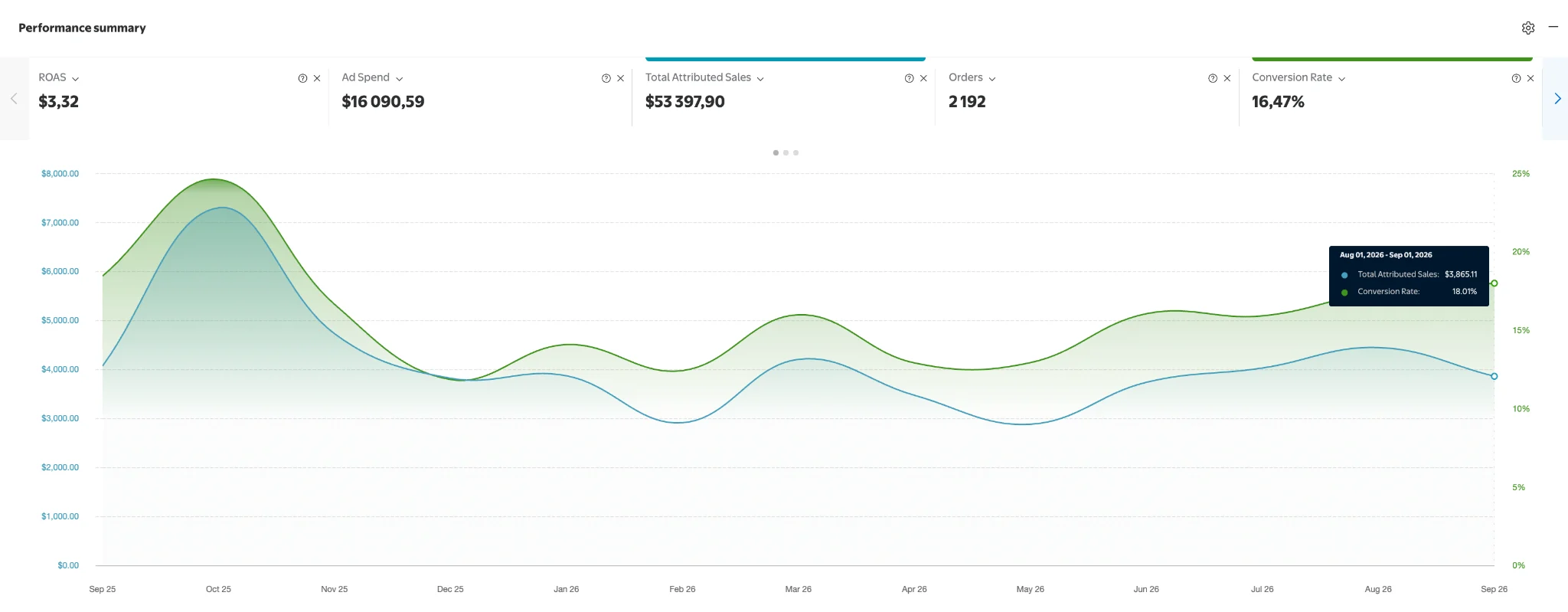
Attributed sales and conversion rate by month. The latest month: $3,865.11 in ad sales at 18.01% conversion.Open full size