
Pet Supplies
Walmart: the account had not failed. It had stopped moving
Campaigns were still running, but growth had gone quiet. Four months later the account produced $84,830 in sales at 6.24× ROAS.
Period: November 2025 to February 2026, four monthsWalmart Advertising

Results
Sales
$84,830
↑ over 4 months
ROAS
6.24×
Average CPC
$1.29
↓ category benchmark $2–3
Reach
1,732,612
Ad spend
$13,596.01
Peak ROAS
7.67×
All changes measured against the account's own pre-engagement performance, where campaigns had stopped scaling.

Run by Maxim Chistokletov.
Why no brand name. The client is under NDA. The marketplace, category, engagement window, and figures are exact; the seller is not named.
A pet supplies seller on Walmart Marketplace had reached the frustrating kind of plateau: nothing looked broken, campaigns were still running, and growth had simply stopped responding.
The category is expensive: $2–3 CPC is the working benchmark, which leaves little room for a campaign structure that wastes clicks.
The brief asked for volume without surrendering efficiency. That tension was exactly where the old structure had run out of road.
What four months produced
Between November 2025 and February 2026:
- $84,830 in sales
- 6.24× ROAS
- $1.29 average CPC
- 1,732,612 reach
The number the others depend on
A $1.29 average CPC in a $2–3 category is what makes the rest possible.
At benchmark CPC, a 6.24× return needs an exceptional conversion rate to compensate. At roughly half the benchmark, the same return is achievable with ordinary conversion, which means it is repeatable rather than lucky.
Getting there was structural, not tactical. The campaigns were rebuilt before they were scaled: structure first, so that added budget lands on placements already proven to convert, rather than inflating spend across placements nobody had separated out.
The three phases
The work ran in a deliberate sequence rather than as continuous optimisation:
November: relaunch. Advertising campaigns rebuilt and traffic segments tested. Nothing was scaled yet; the month was spent finding out what actually converted.
December to January: optimisation. Underperforming targets disabled and budget reallocated to what the launch phase had proven. This is where the CPC advantage was built.
February: scaling. Budget increased against known-good placements, and ROAS peaked at 7.67× against the 6.24× average for the engagement.
Scaling came last because confidence had to be earned first. Spend added in November would have landed on targets nobody had tested yet.
Why Walmart is worth the attention
Walmart carries lower search volume than Amazon, and sellers treat it accordingly: a secondary channel, run with settings copied from Amazon.
That is exactly why the CPCs are winnable. Less competitive pressure per placement means a well-built account can hold a cost position that would be impossible on Amazon in the same category.
The dashboard
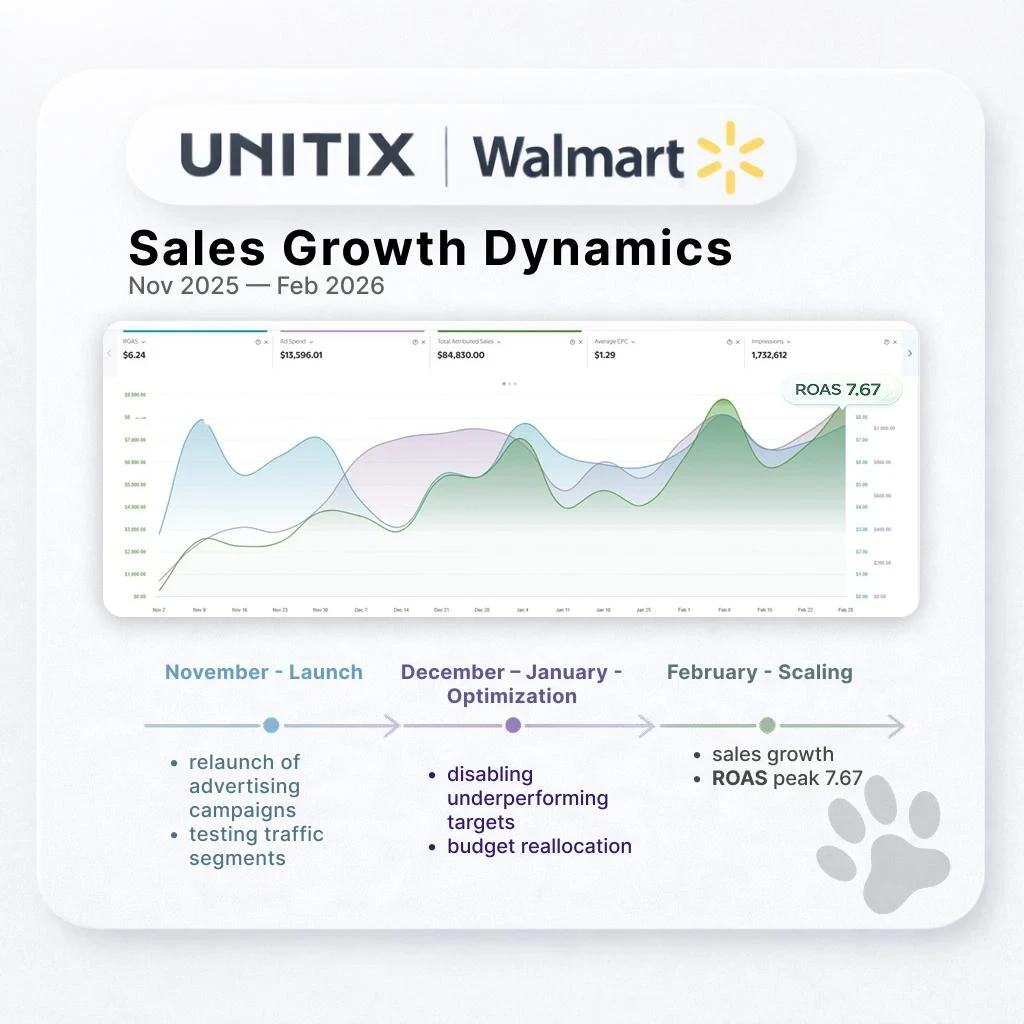
Walmart sales growth, November 2025 to February 2026, with the three engagement phases marked: relaunch, optimisation, and scaling.Open full size