
A review of Amazon keyword tools, by where their numbers come from
Most reviews of Amazon keyword tools rank ten products and never ask the only question that decides whether a number is worth acting on: did the tool measure it, or model it. Here is how to tell, what each kind is good for, and what Amazon gives you free.
By Mariya Tkach, Head of Marketing and Growth, UNITIX Agency
See more UNITIX in Google
Add UNITIX to your Preferred Sources.
Search for the best Amazon keyword tool and you get the same article ten times: a numbered list, the publisher's own product at number one, a table of features copied from marketing pages, a discount code.
We are not going to add an eleventh. Ranking tools against each other is where the bias lives, and everyone doing it sells one.
There is a more useful question, and almost nobody asks it. When a tool tells you a phrase gets 40,000 searches a month, did it measure that, or work it out?
Two kinds of number
Measured. Amazon publishes a Brand Analytics search terms report. For each phrase it gives a search frequency rank, which is that phrase's position by search volume against every other phrase in the marketplace, and it names the three products shoppers clicked most, with each one's share of that term's clicks and of its purchases. Amazon is not estimating any of this. It is reporting what happened inside its own search.
What it does not give you is an absolute number. There is no "40,000 searches" in the report. There is "this phrase was the 812th most searched thing in the United States last month."
Modelled. Almost every commercial tool sells the absolute number. To produce it, something has to convert Amazon's rank into a volume, and how that is done is each vendor's own business. That model can be good. It is still a model, and two vendors modelling the same rank will publish different volumes for the same phrase, which is why sellers regularly find two tools three times apart and assume one of them is broken.
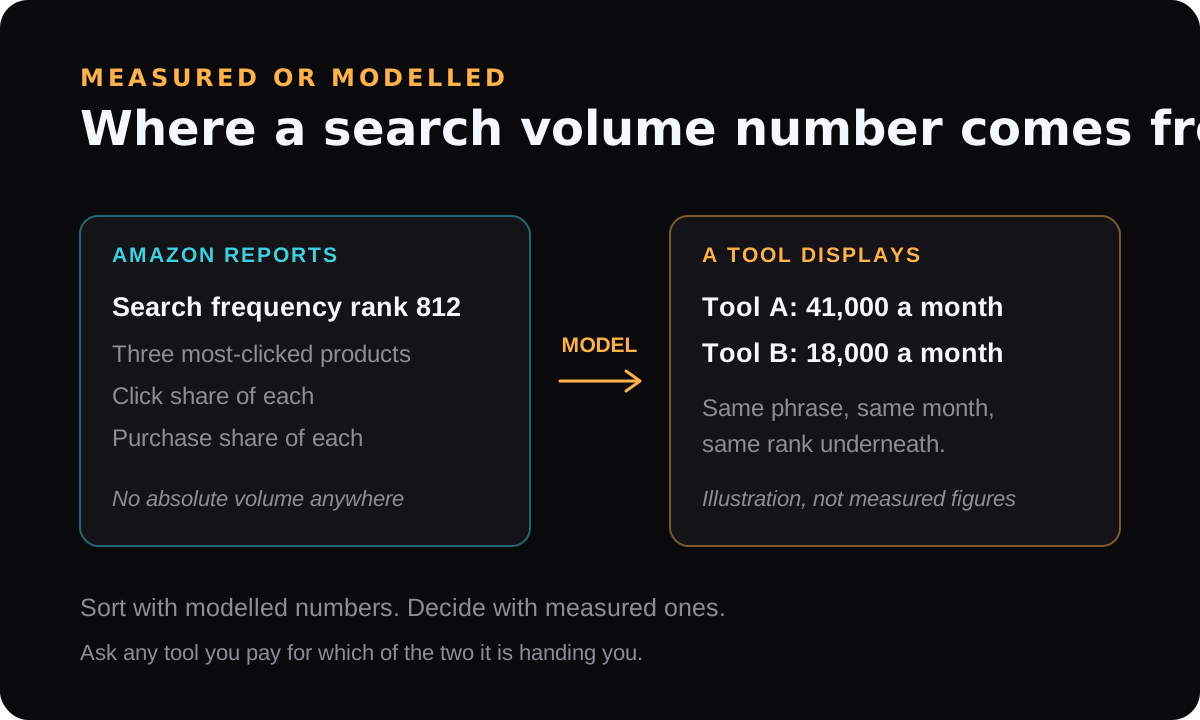
Neither kind is wrong. They answer different questions, and the trouble starts when a modelled number is used for a decision that needed a measured one.
What each kind can carry
A modelled volume is fine for sorting. Is this phrase bigger or smaller than that one, roughly, is a question a model answers well, and it is most of what a keyword list is for.
A modelled volume is not fine for arithmetic. Forecasting units from search volume, setting a budget from projected impressions, or telling a client what a rank-one position is worth in sales all multiply the model's error by whatever else is in the formula.
Measured data carries the decisions where being wrong costs money. Whether a phrase is already owned, which competitor holds it, whether your product converts the attention it gets, and whether you rank at all are all answerable exactly, because Amazon reports them.
How to tell which one you are looking at
Ask the vendor where the number comes from. The answer, or the absence of one, tells you a lot.
We looked at the public pricing and feature pages of the larger tools on 17 August 2026. Helium 10's pricing page describes plans and access levels and says nothing about data sourcing. Jungle Scout's lists what the platform evaluates, including keyword search volume, and likewise does not say where the figure originates. Two other vendors' pricing pages could not be read from here at all, one returning 404 and one 403.
This is not an accusation. Pricing pages are not documentation, and a good model is legitimate work that is expensive to build. But a seller comparing tools has no way, from the pages the vendors put in front of them, to learn which numbers are reported and which are produced. That is worth knowing before you pick.
Three practical tests when the page does not say:
Look for the phrase "search frequency rank" alongside the volume. A tool that shows both is working from the report and adding a model on top, which is the honest arrangement.
Compare one phrase across two tools. Wildly different volumes with similar relative ordering is the signature of two models over the same underlying rank.
Check a phrase you have first-party data for. If you run ads on it, you know roughly what impressions look like.
What Amazon gives you free
The report itself is free to brand-registered sellers inside Seller Central. No tool is required to read it, and it is the source several paid products are built on.
It is worth saying because the roundups never do: before subscribing to anything, look at what you already have. If you hold Brand Registry, the measured half of this article is already in your account.
Its limits are real. The interface is slow to work in, it covers the marketplace rather than your account, and pulling enough of it to answer a question takes either patience or engineering.
Where our own tools sit
UNITIX has affiliate arrangements with Helium 10 and DataDive, and links to both from our homepage. We earn something if you subscribe through those links. That is why neither appears in a ranking here and why no claim is made about the accuracy of anyone's numbers. It is also why this article is organised around a question rather than a leaderboard.
Our free seller tools read the search terms report directly. The keyword tool shows what the three named products hold on a phrase. The ASIN inspector shows which phrases name your product and how its click share compares with its purchase share. The keyword tracker checks organic position and remembers the previous check.
We publish a search volume figure too, so the question this article asks of everyone else has to be answered here.
Where Amazon publishes a count for a query, that count is the number you see, unchanged. For every other phrase the figure is our own estimate, and it should be read as an order of magnitude rather than as a quantity. Each tool page says which of the two you are looking at, and a blank means Amazon publishes nothing for that query rather than that nobody searches it.
So we are in the same position as the vendors above. The difference we would claim is only this: the page tells you which number is which, at the point where you read it.
What our tools do not do is worth saying as plainly. They cover the marketplaces we hold data for rather than all of them. They have no bulk export, no historical archive going back years, and no product research or supplier features. If you need a keyword database with a volume column against every phrase, one of the paid tools is the right purchase and we are not a substitute for it.
They are free, they have no account, and they answer a narrow set of questions exactly rather than a wide set approximately.
The short version
Sort with modelled numbers. Decide with measured ones.
Ask any tool you are paying for which one it is handing you, and treat an unclear answer as an answer.
The full method behind the measured half of this is in our pieces on how concentrated search terms actually are and on the gap between clicks and purchases, both built from the same report. A seasonal example, pulled the same way: what the same report showed for Halloween search terms, a month before the holiday.
Published by UNITIX Agency, an Amazon growth agency and an Amazon Ads Verified Partner. More at unitix.pro/insights.
Check your own product
ASIN Inspector
Paste an ASIN or an Amazon product link. You get the price and Buy Box, rank and how it has moved, ratings, images and video, and the search terms the product is clicked on. Free, and it needs no access to your account.