
Alexa for Shopping answers questions your listing never answers
Your listing says 500 ml and BPA free. The shopper asked whether it fits a school backpack and leaks lying flat. Amazon Rufus answers in sentences, and most listings are written for two words in a search box.
By Alex Tkach, CEO & Co-Founder, UNITIX Agency
See more UNITIX in Google
Add UNITIX to your Preferred Sources.
Amazon renamed Rufus to Alexa for Shopping on 13 May 2026, gave it Alexa's branding and Alexa's memory, and put it in the Amazon navigation bar. The name is new. The problem this article is about is not.
A shopper opens Amazon and types a sentence. Which water bottle will not leak in a seven-year-old's bag. Whether the lens they already own fits this camera. Which dog bed suits a large dog with bad hips.
Amazon's assistant answers those. To answer, it has to decide which products are relevant, and it decides from what it knows about each one.
Here is one of those answers on the live site. The question was for a leakproof water bottle for a child. The assistant did not return a results grid: it named two products and said why each one qualified, in specifications.
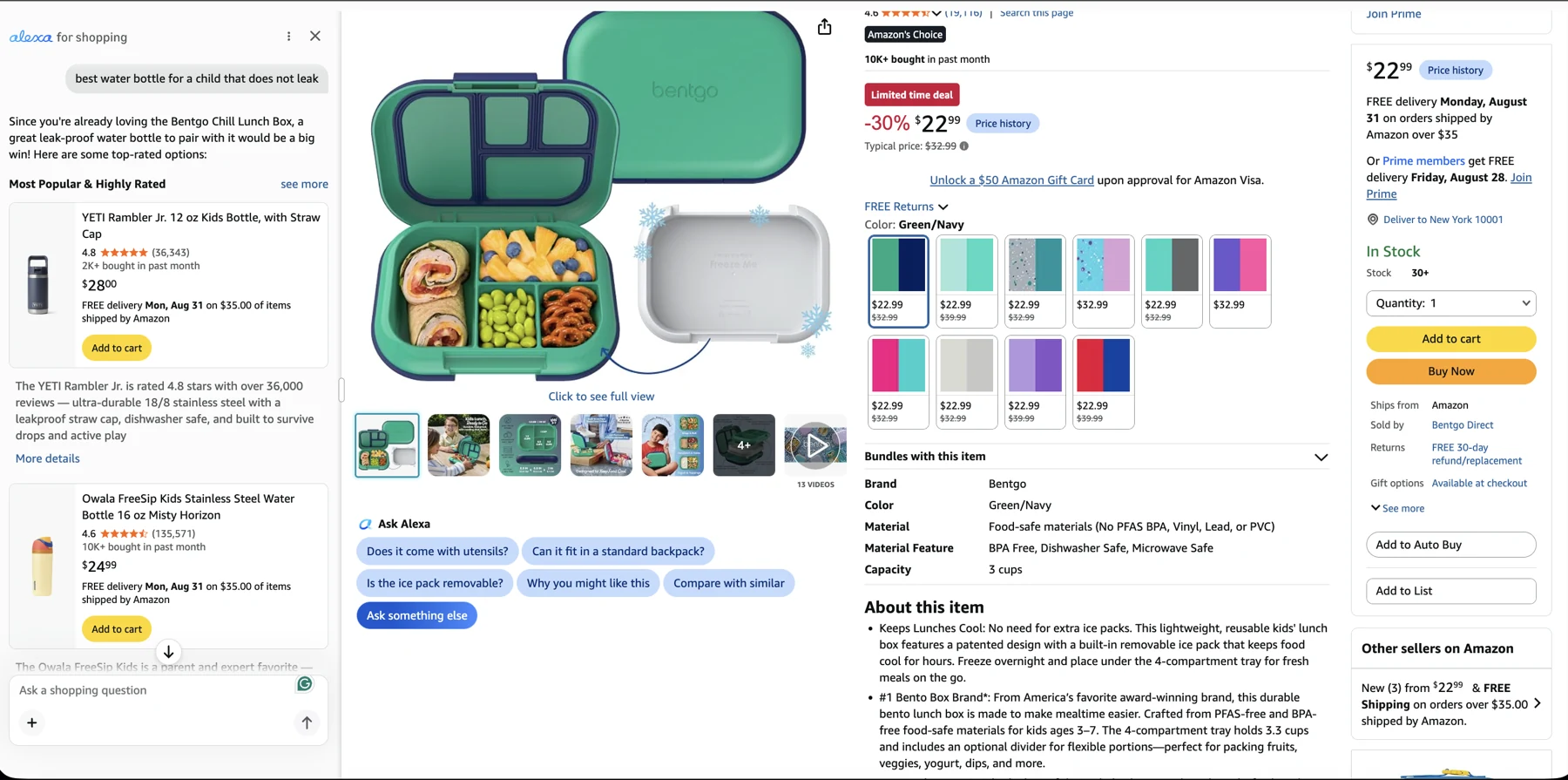
Read what it used to justify the recommendation. 18/8 stainless steel. A leakproof straw cap. Dishwasher safe. Every one of those is a fact somebody wrote into a listing. None of them are adjectives.
That is where most listings stop being useful. They were written for two words in a search box, and they answer two words very well.
The gap is not bad copy
Take a real listing for a children's water bottle. It says 500 ml. It says BPA free. It says stainless steel, double walled, dishwasher safe. Every line is true, every keyword is in place, and the page ranks perfectly well for kids water bottle.
Now read the questions a parent actually asks.
Does it fit a school backpack side pocket. Does it leak lying flat in a bag. Can a seven-year-old open it without help. Does it sweat and soak the books next to it. Is it light enough full.
None of those answers are on the page. Not because the copy is bad, but because nobody thought to write them down. 500 ml and BPA free does not imply any of them, and no system can infer them.
That is the gap. It is almost never a keyword problem.
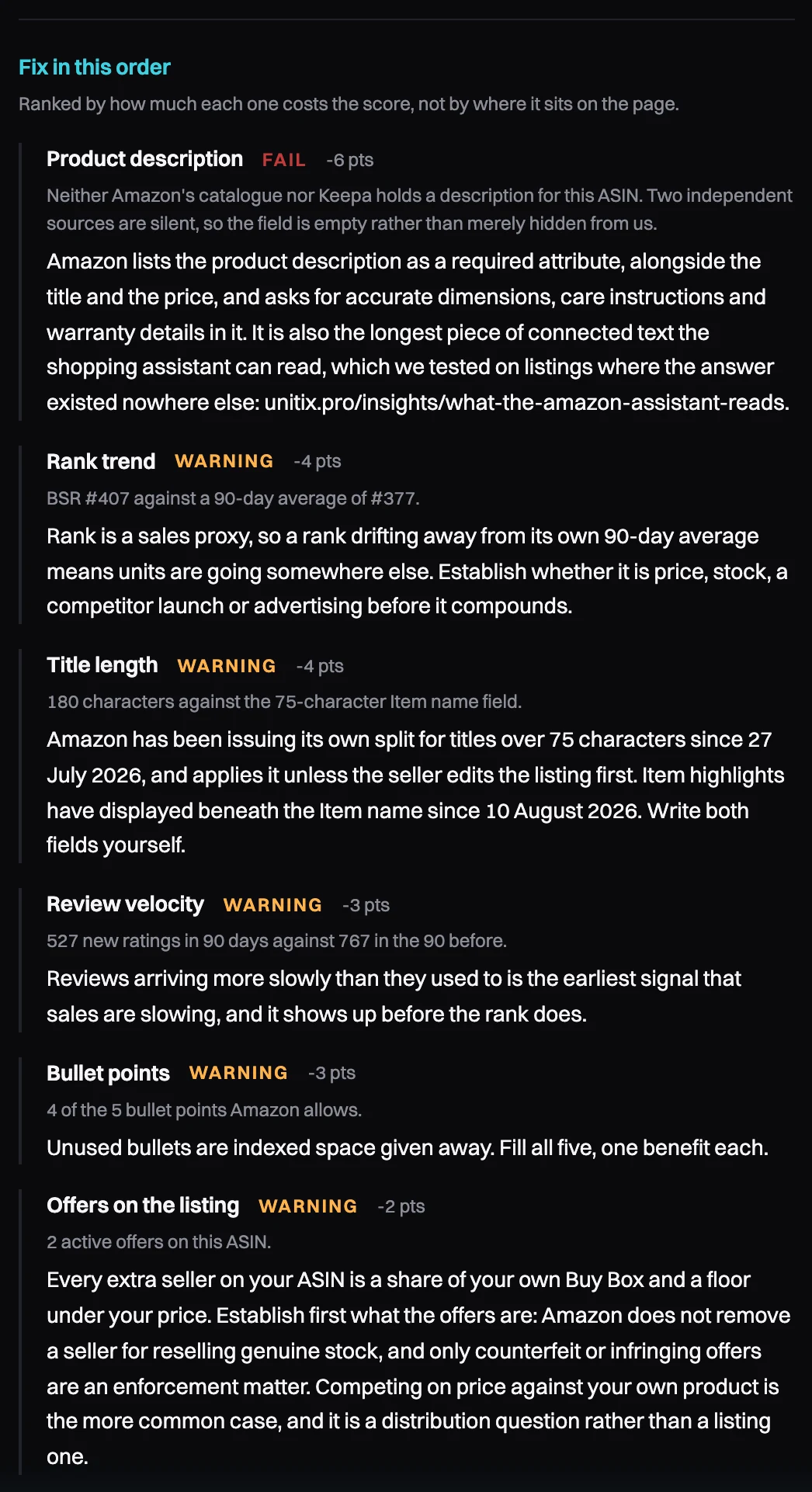
The mechanical half of it is visible from outside the account. This is a real audit of a published listing, scored on what Amazon itself shows a shopper: the title runs 180 characters against a 75-character field, one of the five bullet points is unused, reviews are arriving slower than they were, and the rank is drifting from its own average. None of that needed access to the seller's account.
What Amazon says it reads
Amazon has said its assistant draws on product information from the catalogue, along with customer reviews and the questions shoppers ask each other on the listing.
It has not published which fields carry what weight, and we do not claim to know. What follows from the little that is stated is simple enough to act on: information Amazon cannot read cannot be used. That puts the structured fields on the same footing as the visible copy.
Category, material, dimensions, age range, compatibility and use case are not decoration. They are the places where a product says what it is in a form nothing has to guess at. A listing whose attribute sheet is half empty has handed Amazon a description with the facts removed.
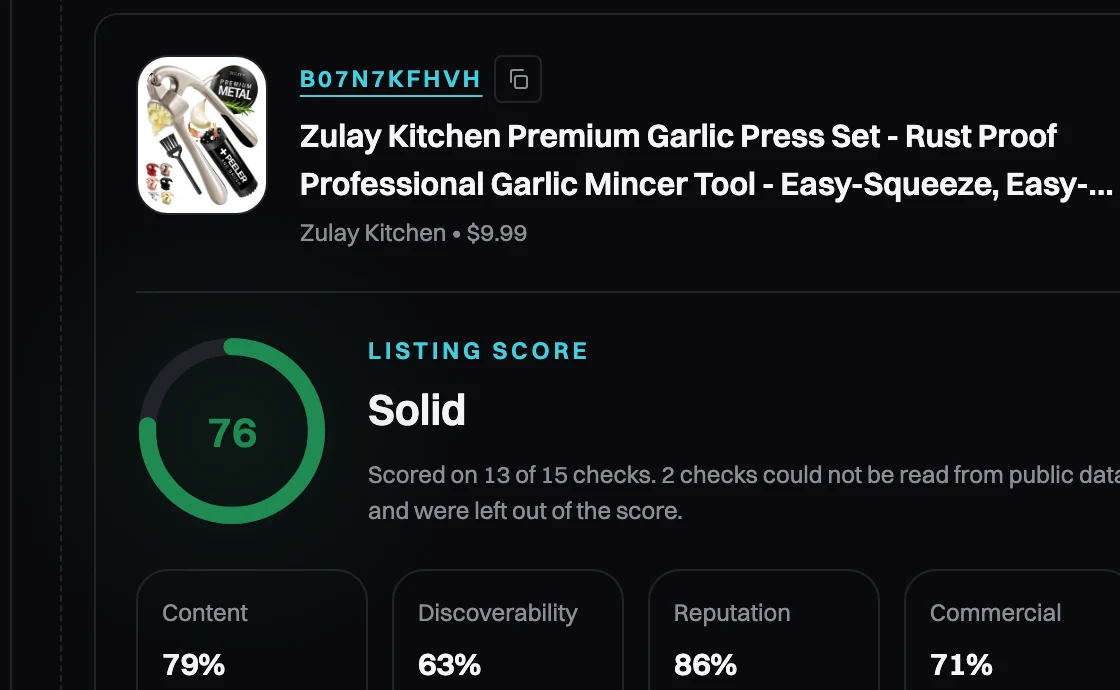
The line worth noticing in the audit below is the small one: thirteen of fifteen checks scored, and two left out because they could not be read from public data.
One is the backend search terms, which Amazon publishes only to the person who owns the listing. The other used to be the description, and that one we learned the hard way. Amazon returns the description attribute for some listings and withholds it for others: ask it about a Goldfish or a Funko listing and it answers with forty attributes, the ingredients, the pallet layout, and no description, while the description sits on the product page for anyone to read. Our audit called that an empty field and took points off for it, which the data did not support, so it was changed to say it did not know.
Saying "I do not know" was honest but not useful, and it has since been fixed properly rather than softened: the audit now reads the description from Amazon's catalogue and from Keepa, and only calls the field empty when both are silent. On the listing below both are, which is why the description now fails outright instead of going unscored. That is the difference between a gap in our data and a gap in the listing, and it took a second source to tell them apart.
It is a useful reminder of the shape of this problem. Some of what matters is visible to everyone, some of it only to you, and the difference decides who can audit what.
Write the answer, not the adjective
The habit worth breaking is the subjective claim. Premium quality, durable construction, perfect for everyday use describe nothing a system can match against a question, and nothing a shopper can verify.
Replace them with the specification underneath.
Not premium materials, but 18/8 stainless steel. Not fits most bags, but 7.3 cm diameter, fits a standard backpack side pocket. Not easy to clean, but the lid separates into two parts and both are top-rack dishwasher safe. Not great for kids, but the age range it was designed for, stated.
Every one of those is a sentence a question can land on.
Your reviews already wrote it
The fastest place to find what is missing is the review section, and it costs nothing.
Buyers describe the product in their own words, mention the situation they bought it for, and say plainly what disappointed them. That vocabulary is usually not the vocabulary of the listing. When forty people write that it fits a lunch bag, the listing should say it fits a lunch bag.
The questions shoppers ask each other on the page are worth the same read. Every one of them is a question the listing failed to answer, written out for you.
Amazon is already reading them, and it will quote them back. Asked on a product page whether a lunch box fits a school backpack side pocket, the assistant answered from the stated dimensions and then from the reviews, in the buyers' own words.
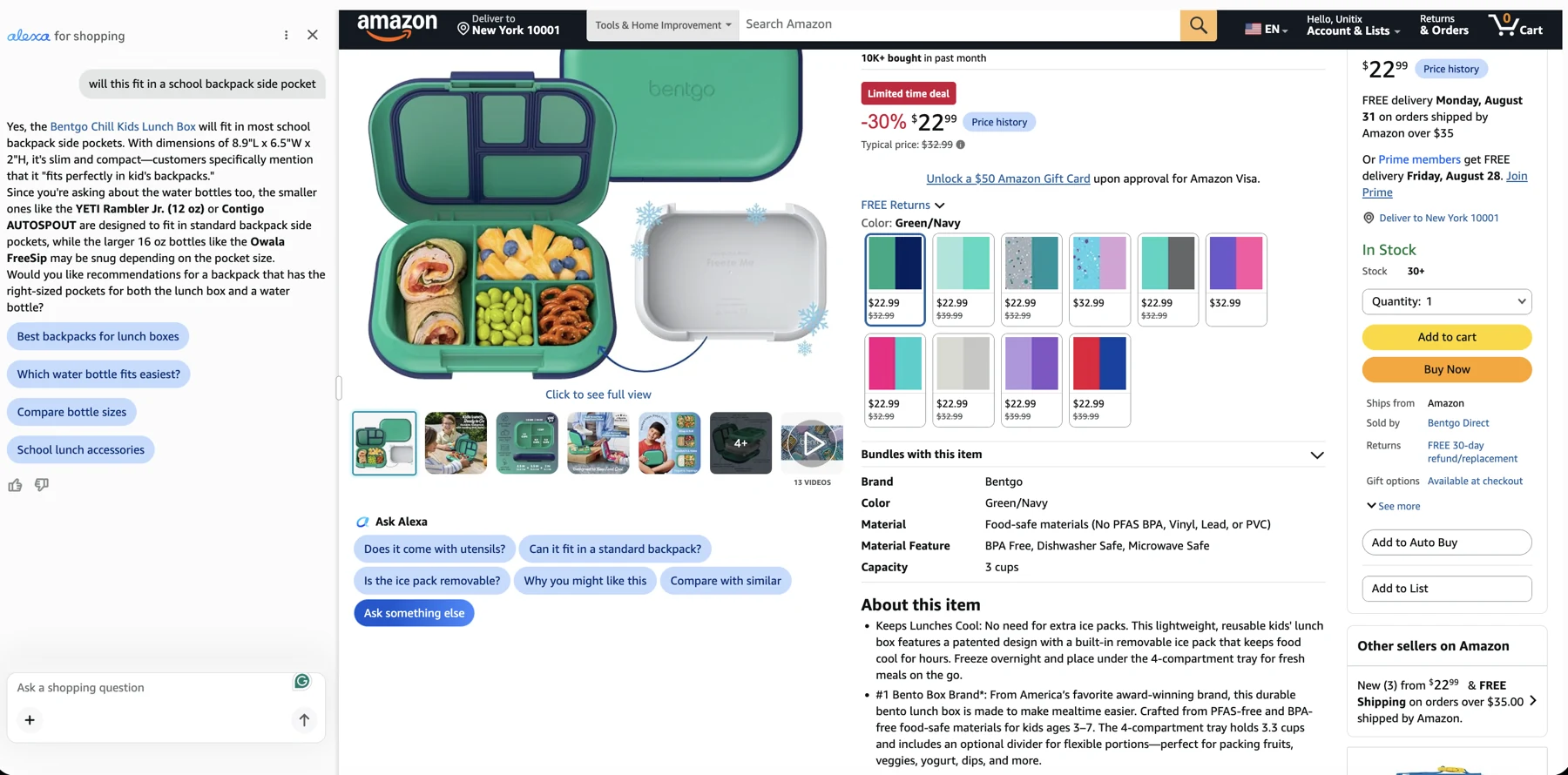
Two sources in one answer: a dimension from the catalogue, and a phrase from a review. A listing that supplies neither has nothing to be quoted from.
The part no listing edit can reach
Here is the thing most articles on this subject leave out.
Product content is one input. Amazon also learns from what shoppers do: what they search for and then buy, what they buy together, what comes back. None of that is edited from a listing.
So the honest description of this work is narrow. Better content gives Amazon more to work with. It does not overrule the rest, and anyone offering guaranteed visibility inside an Amazon assistant is describing something they cannot deliver. There is no placement to buy and Amazon does not publish how the decision is made.
What is left is still worth doing, and it is checkable: state the facts, fill the attributes, answer the questions, and remove the adjectives that answer nothing.
Where to start this week
Pick your best-selling ASIN and write down the ten questions a buyer asks before choosing it. Not keywords. Questions, in full sentences.
Then open the listing and mark which ones it answers. The ones left unmarked are the work, in the order the questions matter.
You can check the mechanical part with our listing audit, which scores a page out of 100 on content, discoverability, reputation and commercial signals and ranks the fixes by what each one costs. It reads only what Amazon publishes, so it works on a competitor's ASIN as well as your own. What it cannot do is know that a parent cares about the backpack pocket. That part is yours.
Published by UNITIX Agency, an Amazon growth agency and an Amazon Ads Verified Partner. More at unitix.pro/insights.
Check your own product
ASIN Inspector
Paste an ASIN or an Amazon product link. You get the price and Buy Box, rank and how it has moved, ratings, images and video, and the search terms the product is clicked on. Free, and it needs no access to your account.