
Home & Kitchen, Furniture
Home & Kitchen furniture: a launch that lost half its year to bans and stock
A new multi-variation furniture product launched near 16% ACoS, then lost months to compliance bans, storage fees, a delayed reorder and a wave of negative reviews. From May to August 2026 profit rose 2.89x.
Period: August 2025 to August 2026Amazon PPC Management, Listing Design

Results
Net profit
2.89x
↑ May to August 2026, $4,973.71 to $14,366.18
Sales
2.4x
↑ May to August 2026, $47,116.73 to $112,546.00
Average ACoS
22.91%
16.05% in the first full month
Advertising
$86,891.29
across the engagement
Purchases from advertising
2,460
All changes measured against the product's own first months after launch, from zero.



Run by Denis Maximovich, Rostyslav Dubil and Maxim Chistokletov.
Why no brand name. The client is under NDA. The category, the window and the figures are given as recorded; the brand, the product and its ASINs are not named.
In August 2025 a client asked us to launch a new multi-variation product in Home & Kitchen, in furniture, from nothing. Before spending anything we read the market, to see where this product was actually strong against what was already selling.
The category turned out to be large. The budget did not match it, so the honest move was to stop treating the whole category as the target and pick the segments where this product could win a click and convert it.
The launch structure
Our specialists worked through the product's semantics first, then built the campaigns around the clusters that came out of it.
The structure leaned deliberately on controlled exact keys, so the advertising appeared in the search results we had chosen rather than the ones Amazon would have chosen for us. Broad formats, auto campaigns above all, were kept to a minimum. Relevance was worth more than reach at this budget.
Video ran heavily alongside it. The client supplied creatives, we kept testing them, and good video did something a still image could not at launch: it explained in a few seconds why this product was different, which moved both sales and brand recall.
None of that would have held up without the listing. Copy and titles were rewritten toward whichever segments mattered for indexation at the time, and main images were tested against each other for click-through rate, because a higher CTR is cheaper advertising for the same bid. That is listing design doing advertising work, and the two are not separable on a launch.
The first full month ran at 16.05% ACoS on a limited budget, and the product started to build.
Then Amazon started banning the variations
From October, Amazon began selectively blocking individual variations for missing compliance certificates.
The immediate loss was the sales, but the damage went further. Blocked variations took their reviews with them, so the listing's rating fell, and a lower rating meant a lower conversion rate on everything that was still sellable. We pulled advertising budgets back rather than pay to send traffic into a listing that could no longer convert it.
Q4 made it worse in a way specific to furniture. The product is bulky, Amazon's storage fees rise in Q4, and bulky stock that is not moving is the most expensive kind to hold.
Clearing stock we were not allowed to sell
The client obtained the certificates and supplied them to Amazon at the end of December, which solved the ban.
It did not solve the inventory. By then the stock was aged, still bulky, and still accruing storage fees, so it had to move quickly and a new shipment had to be ordered. We raised advertising budgets and stopped optimising hard for efficiency. The job that month was volume on the variations that had just come back, not a good ACoS.
The reorder is where the year was really lost. Until late December nobody could be sure the product would pass certification at all, so no new order had been placed. Deciding the new order took further time, and manufacturing only began in February 2026. With production and shipping, that is close to three months.
So from February we were managing scarcity: holding advertising down and sales with it, purely to avoid running out entirely before the new stock landed.
Then the listing came under a wave of negative reviews, which pushed the rating down again at exactly the point we had the least room to respond. Meanwhile individual variations sold out and disappeared, leaving the slower-selling ones in the listing. Conversion followed all of it downward.
There was one correct response available, and it was not a clever one: cut advertising spend and concentrate what was left on the campaigns still returning. Deciding what to keep running is most of what Amazon PPC management is when an account is under pressure.
From May, a normal account again
The new shipment arrived at the end of April 2026. The review and rating problems were resolved. From May we were finally working on the product rather than around it.
A multi-variation listing gives you a pricing instrument, so we used it. Several variations were kept discounted at any given time to keep the listing attractive in the results, and which ones carried the discount was rotated regularly.
May and June went into the campaign structure, to get sales growing. From July, with that growth in place, we began raising prices gradually to recover margin.
Where it stands
Once the product was trading normally again, four months took it from level to the best it had been. Sales went from $47,116.73 in May 2026 to $112,546.00 in August, and net profit from $4,973.71 to $14,366.18. That is profit multiplied by 2.89 while the price was rising rather than falling, which is the part worth reading twice: the growth came from structure and pricing together, not from buying volume cheaply.
A different Home & Kitchen account, with stock behind it and no compliance problem, reached 24.5% of its category in a year. This one spent the same year getting back to level.
Across the whole thirteen months the account spent $86,891.29 on advertising at an average 22.91% ACoS and bought 2,460 purchases through it, against 10.4 million impressions and a 1.17% click-through rate. Monthly advertising grew from $5,463.53 in September 2025 to $14,156.69 in August 2026.
Six of those thirteen months were unprofitable, and the chart above shows it. None of those months were lost to the advertising being wrong. They were lost to a compliance ban, to storage fees on stock that could not be sold, and to a factory lead time that started three months late. What the advertising could do was decide how much of that damage the product carried into the recovery, and how quickly it came back once the stock was on the shelf.
The dashboard
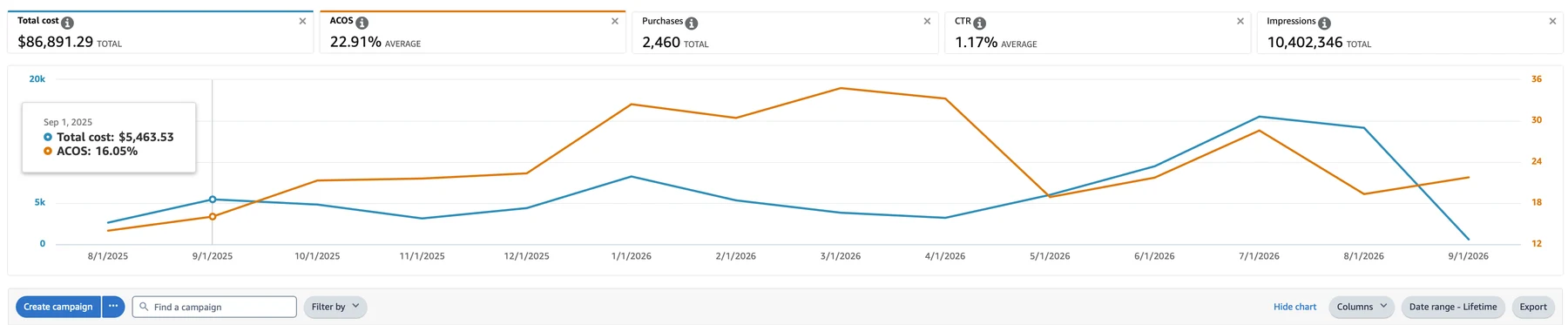
The advertising account across the whole engagement, with September 2025 selected: $5,463.53 spent at 16.05% ACoS. The totals along the top are lifetime figures.Open full size 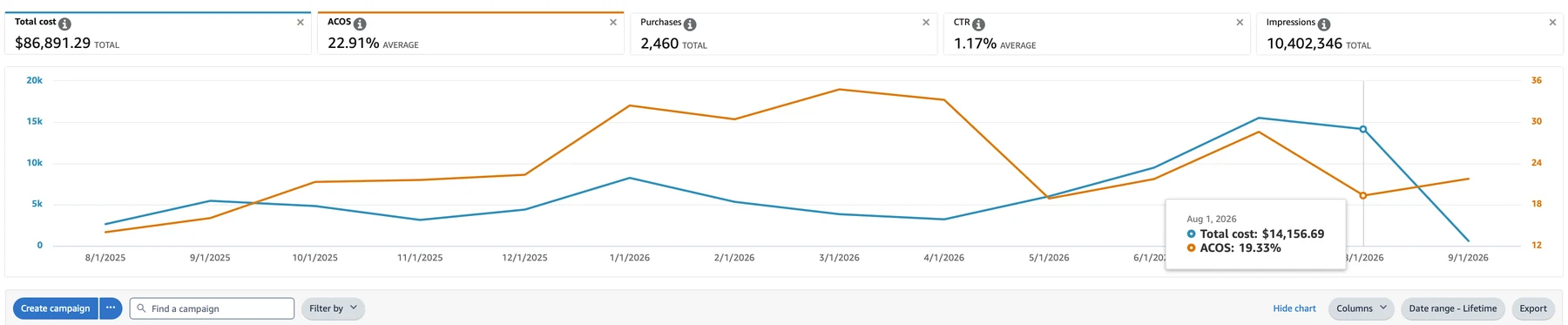
The same chart with August 2026 selected: $14,156.69 spent at 19.33% ACoS. Roughly two and a half times the monthly budget, three points of ACoS higher.Open full size 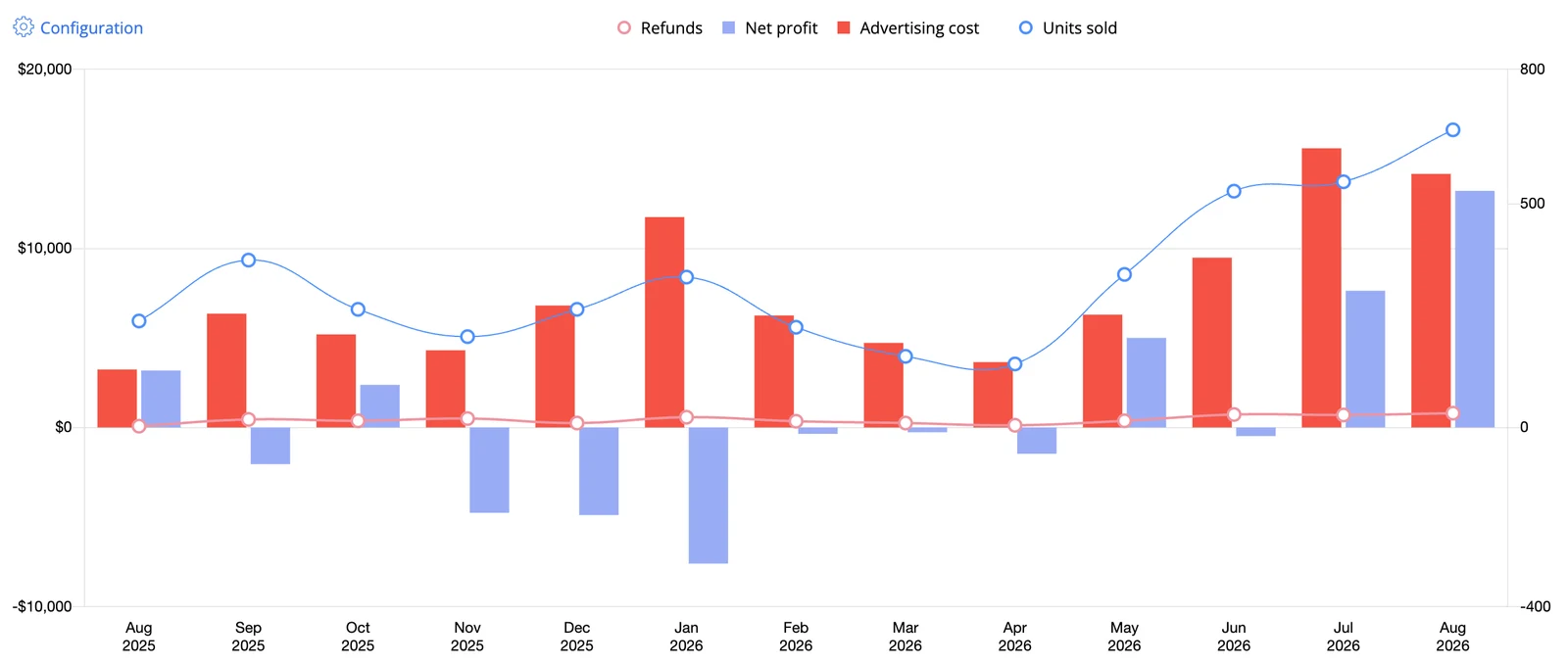
Net profit, advertising cost, refunds and units by month, August 2025 to August 2026. Six of the thirteen months are below the line, which is the compliance and stock period described below. This shows the shape of the year; the exact May and August figures above are read from the account's own reporting, not from this chart.Open full size