
Amazon now requires you to tag AI-generated people in listing images
Most of the risk sits in imagery you published months ago, not in what you upload next. Which files need the keyword, which are exempt, and the point in the workflow where the tag quietly disappears.
By Alex Tkach, CEO & Co-Founder, UNITIX Agency
See more UNITIX in Google
Add UNITIX to your Preferred Sources.
Amazon announced on 22 July 2026 that product images and video containing photorealistic AI-generated people must be tagged with specific metadata before you add them to listings or A+ content. This applies in every Amazon store worldwide.
The requirement follows legislation obliging advertisers to disclose when an image or video contains photorealistic AI-generated people.
What you have to do
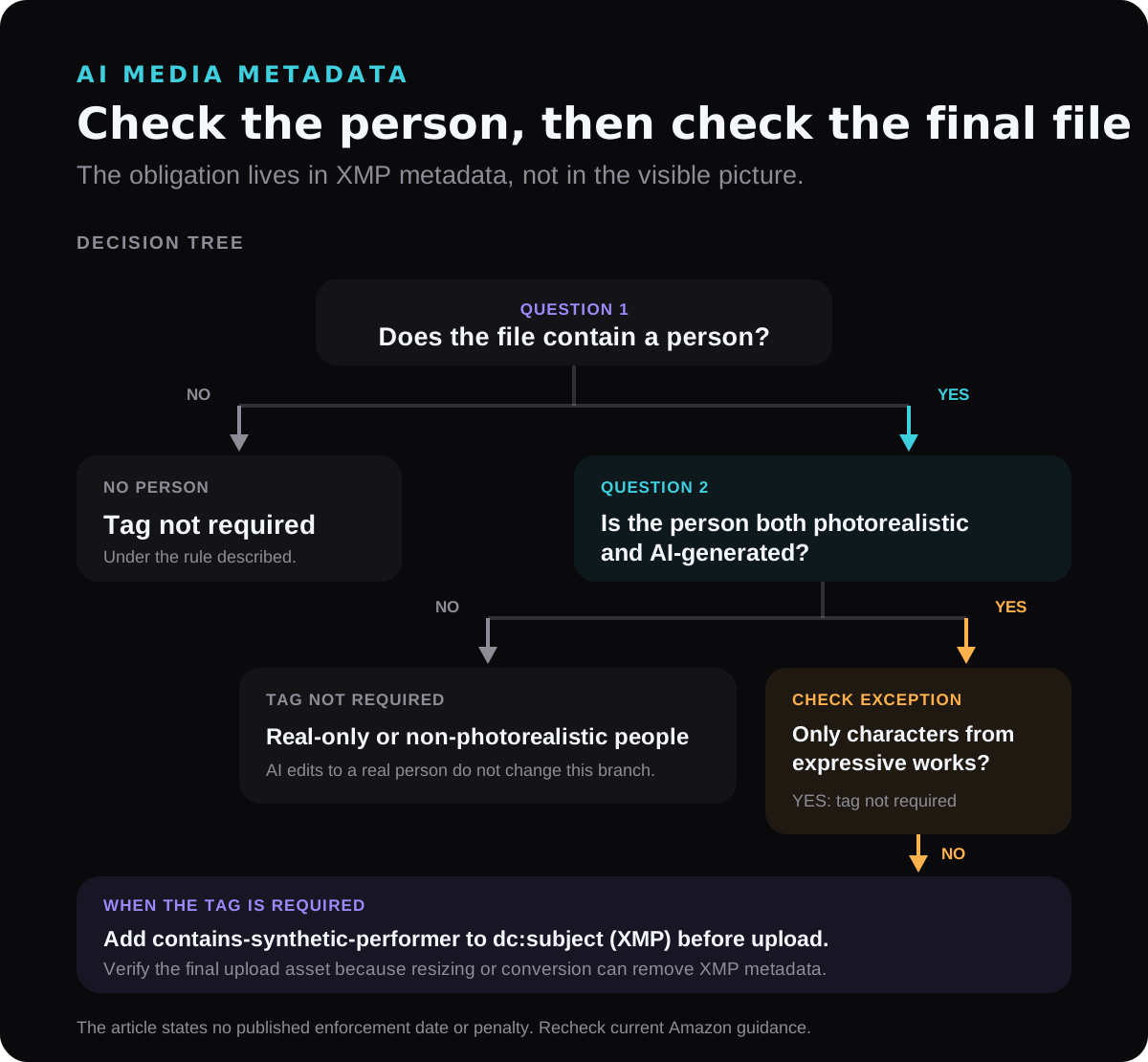
Use an IPTC-compatible metadata editor to add the keyword:
contains-synthetic-performer
to the dc:subject (XMP) field of the image or video file before uploading it.
Where the tag is present, Amazon adds an indicator telling customers the image contains AI-generated people.
When it does not apply
The exceptions are where most of the confusion will sit. You do not need this metadata if the file:
- shows only real people, even if they have been altered with AI tools;
- shows only characters from expressive works, including film, TV, streaming, documentary, or video game content, such as poster art or game cover art;
- contains no people at all;
- contains people who are not photorealistic, because illustration and stylised figures are outside it.
The line is photorealism plus synthetic origin. An AI-retouched photograph of a real model does not qualify. A photorealistic person who never existed does.
Why this catches people out
The obligation lives in metadata, not in the picture. Nothing about a non-compliant image looks wrong on the listing, so nobody notices the omission by looking.
That matters most for catalogues built before the announcement. If AI-generated models were used in lifestyle imagery, which is common in apparel, home, and beauty, those files are already live and already untagged. Nobody will be prompted to fix them.
Two practical consequences:
Uploading is not the only exposure. Any re-upload, variation, or A+ module reusing an existing asset carries the same requirement.
Metadata does not survive every workflow. Resizing, format conversion, and some CDN pipelines strip XMP fields. A file tagged correctly at the design stage can arrive at Amazon without the keyword. Verify the tag on the file you actually upload, not the one you exported.
What we would check first
Any lifestyle imagery produced in the last two years where a human model appears but no photoshoot happened. Then A+ modules, which are easy to forget because they are edited separately from the main image block.
Amazon's announcement gives no enforcement date and states no penalty. That is not a reason to defer. It means the timeline is Amazon's to set, not yours to plan around.
Our own position
We do not use AI-generated people in client listing imagery, and we do not use them on this site. Where a person appears in our work, that person exists.
That is a choice about credibility rather than compliance, and this requirement is a good illustration of why: a rule that only exists to tell buyers when a person is not real says something about how much it matters to them that they are.
Full detail is in Amazon's Seller Central announcement, which sets out the metadata keyword, the field it goes in, and the media it applies to. Amazon's Product image guide and Shoppable video guide carry the same requirement.
Published by UNITIX Agency, an Amazon growth agency and an Amazon Ads Verified Partner. More at unitix.pro/insights.
Check your own product
ASIN Inspector
Paste an ASIN or an Amazon product link. You get the price and Buy Box, rank and how it has moved, ratings, images and video, and the search terms the product is clicked on. Free, and it needs no access to your account.